

Yes, you can accept crypto and card payments together. The decision that matters is where each payment lands. Cards run through a processor, and Stripe's standard US pricing is 2.9% + 30¢ per sale. Crypto can go straight to a wallet you control for only a network fee. So the real question is whether both rails pay into accounts you own, or into a platform that takes 5–13% off every sale first.
TL;DR:
- You can run card and crypto side by side: a card processor like Stripe for cards and your own wallet for Bitcoin, Lightning or stablecoins, both behind one checkout page.
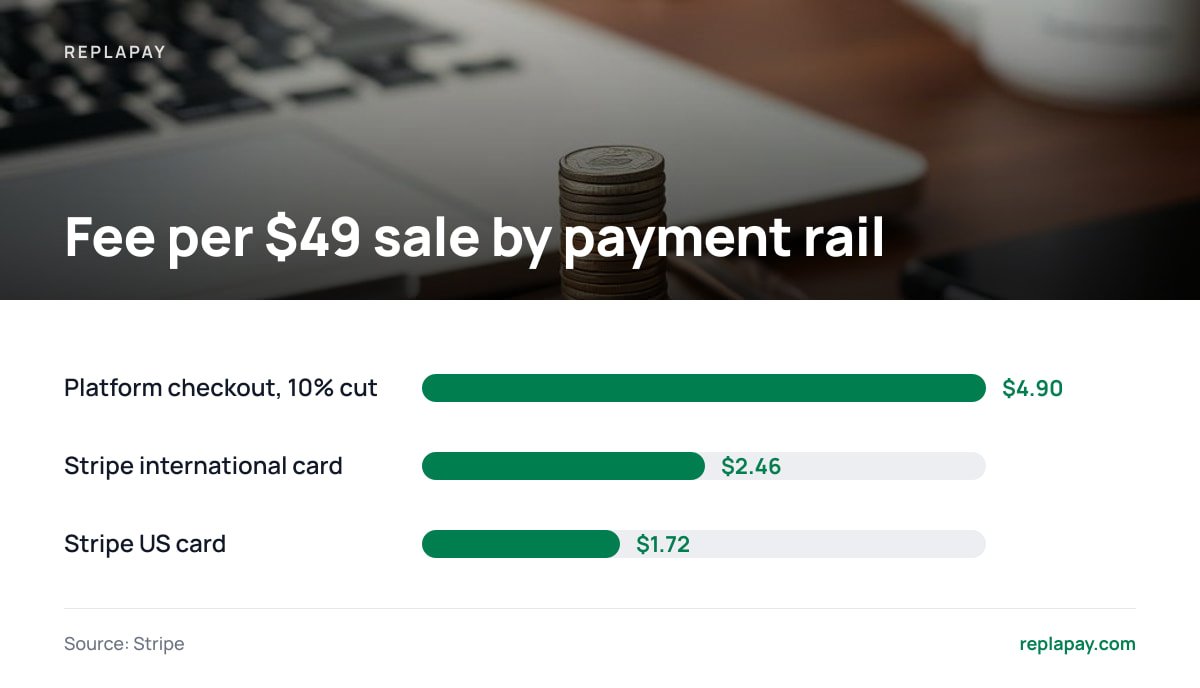
- On a $49 sale, your own Stripe account costs about $1.72 per US card payment, while a 10% platform cut costs $4.90. That gap matters more than whether you add crypto at all.
- Card payments can be disputed for up to about 120 days. Confirmed crypto payments cannot be reversed, which removes chargeback risk but also removes your buyer's safety net.
- In the US, the IRS treats crypto you receive as income at its fair market value on the day you receive it, so log the dollar value of every crypto sale.
- Expect only a small share of buyers to pay with crypto. Add it for the customers who want it, and fix your card fees first.
Table of Contents
- Yes, You Can Accept Crypto and Card Payments Together, Because They Are Two Separate Rails
- What Each Payment Rail Actually Costs You on a $49 Sale
- Three Ways to Accept Crypto as a Payment, Ranked by How Much Control You Keep
- Chargebacks, Volatility and Taxes: The Trade-Offs Behind Each Rail
- Why Adding Crypto Rarely Raises Your Sales, and When It Does
- What Your Buyers Are Asking: Buying Bitcoin With a Card, and Apps That Send It
- How to Spot a Crypto Scammer Before They Cost You a Sale
- Take Card and Crypto Into Your Own Accounts for a One-Time $299 License
- Frequently Asked Questions
- Sources
Yes, You Can Accept Crypto and Card Payments Together, Because They Are Two Separate Rails

A combined checkout is really two payment systems sharing one button row. Card payments travel through the card networks to a processor, which deposits dollars in your bank account. Crypto payments travel over a blockchain, or over Bitcoin's Lightning Network, to a wallet address. No bank sits in the middle. Your checkout's job is to show both options, record which one the buyer used, and mark the order paid when either one clears.
This means you are never choosing between "a card checkout" and "a crypto checkout." You are choosing who controls each rail. There are two main options:
- You own both. Card payments go to your own Stripe account, and crypto goes to your own wallet.
- A platform owns both. A marketplace-style checkout collects the money, takes its percentage, and pays you out later.
Both setups put card and crypto on the same page. Only one of them lets you keep the margin.
If you are in the US, you can legally accept both. One thing to check before you start: Stripe's restricted businesses list limits businesses whose product is crypto, such as exchanges and certain virtual currency services. Selling a course, a template or software, and separately accepting Bitcoin into your own wallet, is a different activity. Still, read the list against your business model before you build anything.
What Each Payment Rail Actually Costs You on a $49 Sale

Most pages on this topic list which coins you can accept. Few show what you keep. Here is the same $49 digital product sold five ways. For a fuller breakdown of card costs, see how much Stripe actually charges per sale.
| Payment rail | Who pays the fee | Cost on $49 | You keep | Settlement | Reversible? |
|---|---|---|---|---|---|
| Platform checkout at a 10% cut | You | $4.90 | $44.10 | Platform's payout schedule | Yes, via card disputes |
| Your own Stripe, US card (2.9% + 30¢) | You | $1.72 | $47.28 | Typically 2 business days in the US | Yes, for up to ~120 days |
| Your own Stripe, international card (+1.5%) | You | $2.46 | $46.54 | Typically 2 business days in the US | Yes |
| Bitcoin via Lightning, to your wallet | Buyer (routing fee) | Usually under a cent | ~$49 in BTC | Seconds | No |
| Bitcoin on-chain, to your wallet | Buyer (network fee) | Varies with network demand | ~$49 in BTC | ~10 min per block | No, once confirmed |
The crypto rows look free, but they come with conditions. If you convert to dollars, you pay whatever your exchange charges. You also carry price risk between the moment the payment arrives and the moment you sell.
The card rows are where most creators lose money. Moving from a 10% platform to your own Stripe account saves $3.18 on every $49 sale. At $5,000 a month in sales, that is roughly $325 a month, or about $3,900 a year, before you accept a single satoshi.
On a $49 sale, a 10% platform cut costs $4.90 and Stripe alone costs $1.72. The $3.18 difference is the price of not owning your checkout.
Three Ways to Accept Crypto as a Payment, Ranked by How Much Control You Keep

The direct answer to "how can I accept crypto as a payment?" is that you need a wallet to receive funds and a way to tell your store when a payment has arrived. There are three common setups, listed here from least control to most.
1. A hosted crypto processor that converts to dollars
A third-party service generates an invoice and watches the blockchain for you. It can convert the coins to dollars before paying you, which removes volatility from your side. The trade-off is that most of these services charge a percentage per transaction, often around 1%. They also hold your funds in transit and require business verification. This option makes sense if you want zero exposure to crypto prices and don't mind a fee.
2. Posting a wallet address or QR code manually
You put a Bitcoin address or Lightning invoice on your page and fulfill orders by hand once the payment shows up. This costs nothing and gives you full control. It also falls apart quickly in practice:
- You have to match each payment to a buyer yourself.
- Buyers send the wrong amounts.
- You end up reusing addresses, which weakens privacy.
This works for occasional tips. It does not work for a product that sells daily.
3. A self-hosted checkout that pays into your own wallet and your own Stripe
Your checkout software does three things automatically:
- It generates a unique address or Lightning invoice for each order.
- It prices the order in dollars and locks the crypto amount for a short window.
- It confirms payment on its own and runs card payments through your Stripe account on the same page.
There is no middleman fee on either rail. This is the option we would pick for anyone selling digital products at volume, and it is the setup covered in detail in how to accept Bitcoin payments on your website without losing a cut.
Pro Tip: Write your crypto refund policy before your first crypto sale, and state that refunds are issued at the original dollar price. Without that line, a buyer who paid 0.0008 BTC can ask for 0.0008 BTC back after Bitcoin has risen 20%, and nothing in your terms says no. Also require refunds to go to an address the buyer confirms in writing, never to "the address it came from." Payments sent from an exchange often come from shared addresses the buyer does not control.
Chargebacks, Volatility and Taxes: The Trade-Offs Behind Each Rail
Each rail moves risk to a different place, and you should know where it lands before you advertise both.
- Chargebacks favor crypto. On the major card networks, buyers can generally dispute a charge for up to about 120 days, and Stripe adds a $15 dispute fee in the US on top of the reversed amount. Confirmed Bitcoin transactions cannot be undone. The Bitcoin whitepaper was written specifically to remove the need for a trusted party that can reverse payments.
- Volatility favors cards. A $49 card sale is $49 when it settles. A $49 Bitcoin sale is worth whatever Bitcoin is worth when you sell it. You can avoid this by accepting dollar stablecoins, but the issuers of the major stablecoins can freeze addresses, so "pegged" does not mean "risk-free."
- Confirmations are a judgment call. Many merchants accept one on-chain confirmation for small digital orders and wait for three or more on large ones. Lightning payments settle once the invoice is paid, which is why Lightning suits low-priced products.
- Taxes apply the moment you are paid. The IRS treats digital assets as property. If you receive crypto as payment for goods or services, you report its fair market value in dollars as income on the day you receive it. When you later sell or spend that crypto, you have a separate gain or loss. Record the dollar value at receipt for every crypto order, because your wallet will not do it for you.
A card buyer can generally dispute a charge for up to 120 days. A Bitcoin buyer cannot reverse a confirmed payment at all.
Why Adding Crypto Rarely Raises Your Sales, and When It Does
The common assumption is that adding crypto opens a new customer base. For most creators, that assumption is wrong. People who read forum threads about whether accepting crypto is a good idea tend to report the same thing: a small share of buyers choose it, and almost all of them would have paid by card anyway.
Crypto does help in three specific situations:
- International buyers with weak card access. These buyers face cards that decline on foreign merchants, high cross-border fees, or no card at all. Lightning or stablecoins may be the only way they can pay you.
- Audiences that already hold crypto. If you sell to developers, privacy-minded buyers, or the crypto space itself, demand is real. These buyers notice when the option is missing.
- Products prone to chargebacks. Digital goods with "I didn't get it" dispute patterns get hit hard by card disputes. Steering even a slice of buyers to an irreversible rail reduces that exposure.
If none of these describes your audience, add crypto because it costs you little. Fix your card fees first, because that is where the money is. For the bigger structural decision, see merchant of record versus your own payment processor at three revenue levels.
What Your Buyers Are Asking: Buying Bitcoin With a Card, and Apps That Send It
When you add a crypto button, some buyers will try it for the first time. These are the questions they bring with them.
Can I buy Bitcoin with just a credit card?
Usually yes, but "just" overstates it. Many exchanges accept credit cards, but you will still need to verify your identity, because US exchanges are regulated as money services businesses. Many card issuers also code crypto purchases as cash advances, which typically means:
- an upfront fee, often 3–5%
- a higher interest rate
- no grace period
Some issuers block crypto purchases entirely. Add the exchange's own card fee, and buying Bitcoin to pay a $49 invoice can cost the buyer more than paying that invoice by card directly. Keep this in mind before you push buyers toward crypto with a discount.
Is there a Bitcoin app that can send money?
Yes. Any Bitcoin wallet app can send to an address or a Lightning invoice. Several mainstream US payment and banking apps also let users buy, hold and send Bitcoin from inside the app. Some of those apps only send within their own network, or only send on-chain, so a buyer may not be able to pay a Lightning invoice from them. Your checkout should show an on-chain address as a fallback.
Can you pay with Bitcoin without a wallet?
Not really. You can pay without managing your own keys, by sending from a balance held on an exchange or in a payment app. That balance is still a wallet; someone else just controls it. Paying from a custodial balance is convenient, but it is also how buyers end up sending from addresses they cannot receive refunds to.
How to Spot a Crypto Scammer Before They Cost You a Sale
Crypto fraud is not a fringe problem. The FBI's Internet Crime Complaint Center has reported cryptocurrency-related fraud losses in the billions of dollars per year. The FTC's guidance on cryptocurrency scams puts the core rule plainly: only scammers demand payment in cryptocurrency.
From the buyer's side, the FTC's warning signs include:
- guaranteed returns or promises of big money
- someone you met online who steers the conversation to crypto investing
- anyone claiming to be a government agency, utility or well-known company who demands payment in crypto
As a merchant, watch for a different set of tricks:
- The overpayment. A buyer "accidentally" sends $490 instead of $49 and asks you to refund the difference to a new address. Often the original payment was never confirmed, or was sent with a fee so low that it will never confirm.
- The screenshot. The buyer sends a picture of a transaction instead of letting your checkout detect it. Fulfill orders based on what your system confirms, never on an image.
- The rush. The buyer pressures you to deliver before confirmations arrive on a large on-chain order. If someone is in that much of a hurry, ask them to pay over Lightning or by card.
- The swapped address. Someone emails "updated payment details" or asks you to refund to an address that doesn't match the order. Verify through a channel you started, not one they started.
Take Card and Crypto Into Your Own Accounts for a One-Time $299 License
The problem described above has a direct fix: put card and crypto on one checkout page, and have both pay into accounts you own. ReplaPay is self-hosted checkout software that does exactly that. Card payments go straight to your own Stripe account. Bitcoin, Lightning and stablecoin payments go straight to your own wallet. Payment links work for both rails. The license is a one-time $299 and includes 12 months of updates and 30 days of setup support, so there is no percentage of each sale on top of Stripe's own fees. Run your numbers through our Stripe fee calculator to see the gap at your volume.
One honest caveat: owning the checkout means owning the responsibilities a marketplace used to handle for you. That includes sales tax and VAT collection, hosting, and keeping your wallet secure. If you want to compare options before committing, see our honest comparison of crypto checkout software for small business, and check every spec sheet against your needs, including ReplaPay's.
Frequently Asked Questions
Can I accept crypto and card payments together in the USA?
Yes. It is legal for US businesses to accept both. Typically, cards run through a processor like Stripe and crypto goes to a wallet you control. The IRS treats crypto you receive as income at its fair market value on the day you receive it, so record the dollar value of each crypto sale.
How can I accept crypto as a payment on my website?
You need a wallet to receive funds and a checkout that creates a unique address or Lightning invoice for each order and detects payment automatically. You can use a hosted processor that charges a per-transaction fee, post a wallet address manually, or run self-hosted checkout software that pays into your own wallet.
Is accepting crypto cheaper than accepting cards?
Usually, yes. Bitcoin network fees and Lightning routing fees are paid by the buyer, and receiving funds directly into your own wallet costs you nothing per transaction. However, you take on price volatility and pay exchange fees if you convert to dollars, so the true cost depends on how and when you cash out.
Can a customer get a chargeback on a crypto payment?
No. Once a Bitcoin transaction is confirmed, it cannot be reversed by the buyer, a bank or a card network. This protects you from fraudulent disputes, so you need a clear written refund policy that you honor voluntarily.
How do I avoid crypto overpayment scams as a seller?
Never refund an "overpayment" until your own checkout has confirmed the full amount on-chain. Never refund to a new address the buyer supplies by email. Fulfill orders only from payment confirmations your system detects, not from screenshots.
Sources
- Stripe Pricing | Stripe
- Restricted Businesses | Stripe
- Digital Assets | Internal Revenue Service
- What To Know About Cryptocurrency and Scams | Federal Trade Commission
- Internet Crime Complaint Center | Federal Bureau of Investigation
- Bitcoin: A Peer-to-Peer Electronic Cash System | Bitcoin.org