

Stripe takes 2.9% plus $0.30 per successful US card transaction under its standard pricing — not 20%, and not a flat cut that scales with your business size. The number that actually matters is what happens after Stripe: marketplace checkout platforms layer their own 5–10% commission on top of Stripe's processing cost, which is why sellers who think they're paying "Stripe fees" are often paying a platform fee that has nothing to do with Stripe at all.
TL;DR:
- Stripe's standard rate is 2.9% + $0.30 per successful US card charge, and it never charges anywhere near 20%.
- On a $1,000 sale you net $970.70 after standard Stripe fees, before any platform markup gets added.
- International cards add 1.5%, currency conversion adds another 1%, and instant payouts cost an extra 1% on top.
- Most of that 2.9% moves through Stripe to card networks and issuing banks — it doesn't all stay with Stripe.
- Marketplace checkout platforms charging 5–13% are stacking their own commission on top of Stripe's processing cost, not replacing it.
Table of Contents
- Stripe's Actual Rate, and Why the Marketplace You Use Charges More
- What $1,000 in Sales Actually Nets You
- Does Stripe Take 20%? Where That Number Actually Comes From
- Why Stripe Fees Feel High, and Who Actually Keeps the Money
- Stripe vs. PayPal: The Real Difference Isn't the Headline Rate
- International Cards, Currency Conversion, and Global Payouts Pricing
- Can You Pass Stripe Fees to Customers? What the Card Networks Allow
- Who Pays Stripe Fees, in Practice
- Stop Paying a Recurring Cut for What Stripe Already Does
- Frequently Asked Questions
- Sources
Stripe's Actual Rate, and Why the Marketplace You Use Charges More

Stripe's published standard rate for US-issued cards processed online is 2.9% plus $0.30 per successful transaction, according to Stripe's own pricing page. That rate is flat regardless of your monthly volume — Stripe doesn't have a tiered public pricing structure that drops your percentage as you scale, though it does negotiate custom rates privately with high-volume accounts. The confusion around "what percentage Stripe takes" almost always traces back to a different number entirely: what a checkout platform built on top of Stripe charges you. If you sell through a marketplace-style platform, Stripe's 2.9% + $0.30 gets paid first, and then the platform adds its own commission — often 5% to 10% — before the rest reaches you.
2.9% + $0.30. That is Stripe's entire standard processing rate for a successful US card charge, whether you process $50 a month or $50,000.
What $1,000 in Sales Actually Nets You

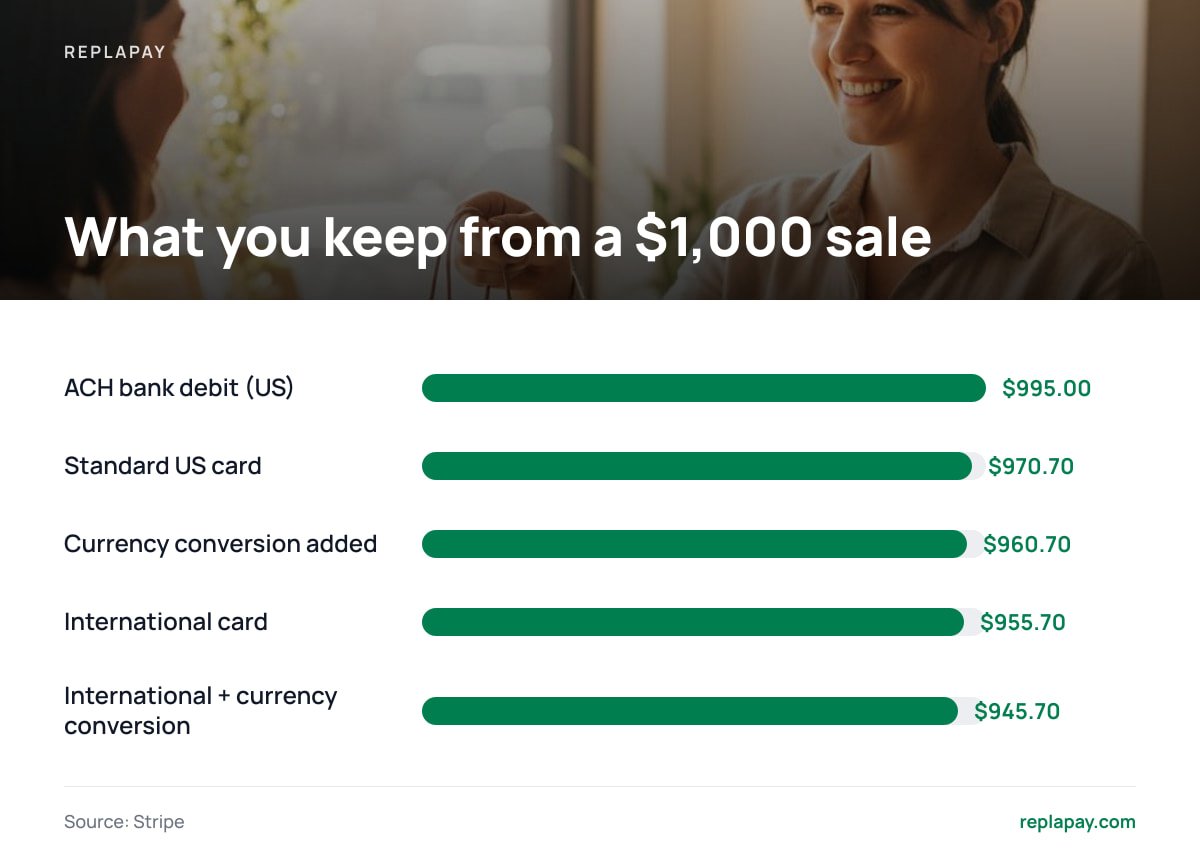
Running the math on a round number makes the fee structure concrete instead of abstract. Here's what a $1,000 charge looks like at Stripe's standard rate, and how the number moves as you add common surcharges.
| Scenario | Fee formula | Fee amount | You keep |
|---|---|---|---|
| Standard US card | 2.9% + $0.30 | $29.30 | $970.70 |
| International card | 4.4% + $0.30 | $44.30 | $955.70 |
| Currency conversion added | 3.9% + $0.30 | $39.30 | $960.70 |
| International + currency conversion | 5.4% + $0.30 | $54.30 | $945.70 |
| ACH bank debit (US) | 0.8%, capped at $5 | $5.00 | $995.00 |
That last row is the one most sellers never check. For invoices over about $625, ACH debit is dramatically cheaper than a card, because the fee caps at $5 no matter how large the transaction. If you're billing a client $5,000 for a project, routing that through ACH instead of a card saves you roughly $140 versus the standard card rate.
Pro Tip: If you send recurring invoices for anything over a few hundred dollars, add a bank debit option at checkout and default to it. Most business customers don't care which payment method they use — they care about getting invoiced — so the savings are almost pure upside with zero pushback.
Does Stripe Take 20%? Where That Number Actually Comes From
No — Stripe has never charged anything close to 20% on a standard card transaction, and there's no plan or tier where that becomes true. The 20% figure people cite usually comes from one of three unrelated sources getting blended together in their head: app store commissions (Apple and Google both take 15–30% on in-app purchases, which has nothing to do with Stripe), stacked marketplace fees (a platform's 10% commission plus Stripe's ~3% plus a currency conversion fee can approach 15–17% in edge cases, which still isn't 20% but gets rounded up in conversation), or affiliate and reseller cuts that some creators bundle into their mental math of "what payments cost me." If you're seeing a 20% deduction on your payouts, the cause isn't Stripe's processing fee — it's a platform commission sitting on top of it, and it's worth tracing exactly where that number is coming from before you accept it as a cost of doing business.
Why Stripe Fees Feel High, and Who Actually Keeps the Money
Stripe doesn't keep the full 2.9%. The majority of that fee is interchange — the cut that goes to the bank that issued your customer's card, set by Visa, Mastercard, and other networks, not by Stripe. Stripe adds its own margin on top of interchange plus a network assessment fee, but the bulk of what you pay moves through Stripe to banks and card networks rather than staying with the company. That's a structural reason payment processing fees across the entire industry — Stripe, PayPal, Square, Adyen — cluster in a similar 2.5%–3.5% band: none of them control the largest input cost. What Stripe does control is fraud tooling, chargeback handling, instant payout infrastructure, and the developer experience, which is where its pricing above the bare interchange rate is actually going.
Stripe vs. PayPal: The Real Difference Isn't the Headline Rate

Stripe and PayPal's standard US rates sit close enough to call a wash — PayPal's standard online rate is also roughly 2.99% plus a fixed fee per transaction, per PayPal's published merchant fee schedule. The difference that actually matters shows up in three places: PayPal charges a separate, higher cross-border fee (historically up to around 4.4% percentage-based, on top of the fixed fee) for international transactions, its currency conversion markup tends to run higher than Stripe's flat 1%, and PayPal exposes far less transaction-level detail for reconciliation than Stripe's dashboard and API do. If you sell primarily to a domestic US audience, the two are close to interchangeable on cost. If a meaningful share of your customers pay from outside the US, Stripe's international and conversion fees are usually the cheaper and more predictable path.
International Cards, Currency Conversion, and Global Payouts Pricing
Three separate surcharges stack on top of Stripe's base rate depending on where your customer's card was issued and what currency they pay in: a 1.5% international card fee when the card was issued outside your Stripe account's country, a 1% currency conversion fee when the charge is processed in a currency different from your payout currency, and — if you're paying out to a bank account in a different country than your Stripe account, which is where Stripe Connect and Global Payouts pricing come in — an additional payout fee that varies by destination country and is listed on Stripe's own pricing page rather than being one flat number worldwide. If you sell internationally, run your actual numbers through a dedicated calculator rather than assuming the domestic 2.9% applies, because the gap between 2.9% and 5.4% on volume adds up fast at scale.
Can You Pass Stripe Fees to Customers? What the Card Networks Allow
You can add a surcharge for card payments in most US states, but the rules aren't uniform, and getting them wrong risks a merchant account penalty rather than just an awkward customer conversation. Visa's merchant surcharging rules require advance disclosure, a surcharge capped at your actual processing cost, and registration with the card network before you turn it on — and a handful of states (including Connecticut and Massachusetts, at various points) have restricted or banned surcharging outright, so check current state law before enabling it. In the European Union, this isn't optional: the EU's Payment Services Directive (PSD2) prohibits merchants from surcharging consumers for payments made with Visa or Mastercard consumer cards, full stop. If your customer base is mixed US and EU, the safest default is building the fee into your price rather than trying to maintain two different surcharge policies.
Who Pays Stripe Fees, in Practice
Stripe deducts its fee from the gross charge automatically — you never pay it separately, and your customer never sees it unless you've explicitly built a surcharge into checkout. That means the seller absorbs the cost by default, which is exactly why the platforms discussed above matter so much: a 3% processing fee is a rounding error, but a platform adding its own 5–10% commission on top, taken from every sale before you see it, is a business decision worth questioning. This is also the core distinction covered in What Is a Merchant of Record? The Distinction That Costs You Money — a merchant of record takes on tax liability and chargeback risk in exchange for that bigger cut, and whether that trade is worth it depends entirely on how much tax complexity you actually have.
Stop Paying a Recurring Cut for What Stripe Already Does
If you're currently on a platform charging 5–13% per sale, most of that isn't Stripe's fee — it's the platform's commission for hosting your checkout. ReplaPay is a self-hosted checkout license, a one-time $299 payment, that connects directly to your own Stripe account and crypto wallet so you pay Stripe's standard processing rate and nothing else on top. It includes card and crypto payment links, 12 months of updates, and 30 days of setup support. The honest caveat: you're managing your own Stripe account and tax handling instead of a marketplace doing it for you, so if you specifically need merchant-of-record tax remittance, check whether that trade-off works for your business before you switch.
Frequently Asked Questions
How much is the Stripe fee for $1000?
At Stripe's standard US rate of 2.9% plus $0.30, a $1,000 card charge costs $29.30 in fees, leaving you with $970.70. That figure rises if the card is international, if currency conversion applies, or if you use instant payouts, each of which adds its own separate fee on top.
Does Stripe take 20%?
No. Stripe's standard processing rate is 2.9% plus $0.30 per transaction, nowhere close to 20%. The 20% figure people reference is usually an app store commission, a stacked marketplace fee, or a mix of costs unrelated to Stripe's own rate.
Why are Stripe fees so high?
Most of Stripe's fee is interchange, the cut set by card networks like Visa and Mastercard and paid to the customer's issuing bank, not to Stripe. Stripe's own margin on top covers fraud prevention, chargeback handling, and payout infrastructure.
What is cheaper, Stripe or PayPal?
For domestic US transactions, Stripe and PayPal's standard rates are close enough to be a wash, both around 2.9%–3% plus a fixed fee. For international sales, Stripe tends to be cheaper because PayPal's cross-border and currency conversion markups typically run higher.
Can you pass Stripe fees to customers?
In most US states you can add a card surcharge if you disclose it in advance and cap it at your actual processing cost, following Visa and Mastercard's surcharging rules. In the European Union, PSD2 bans surcharging consumers on Visa and Mastercard consumer cards entirely.
Does Stripe cost money to use beyond the per-transaction fee?
The core account itself is free to open; you only pay when you actually process a transaction. Additional Stripe products like Billing, Tax, Radar for fraud, and instant payouts carry their own separate fees on top of the base processing rate.
Sources
- Pricing & Fees | Stripe
- Merchant Fees | PayPal
- Payment Services Directive 2 (PSD2) | European Commission
- Merchant Surcharging Rules | Visa