
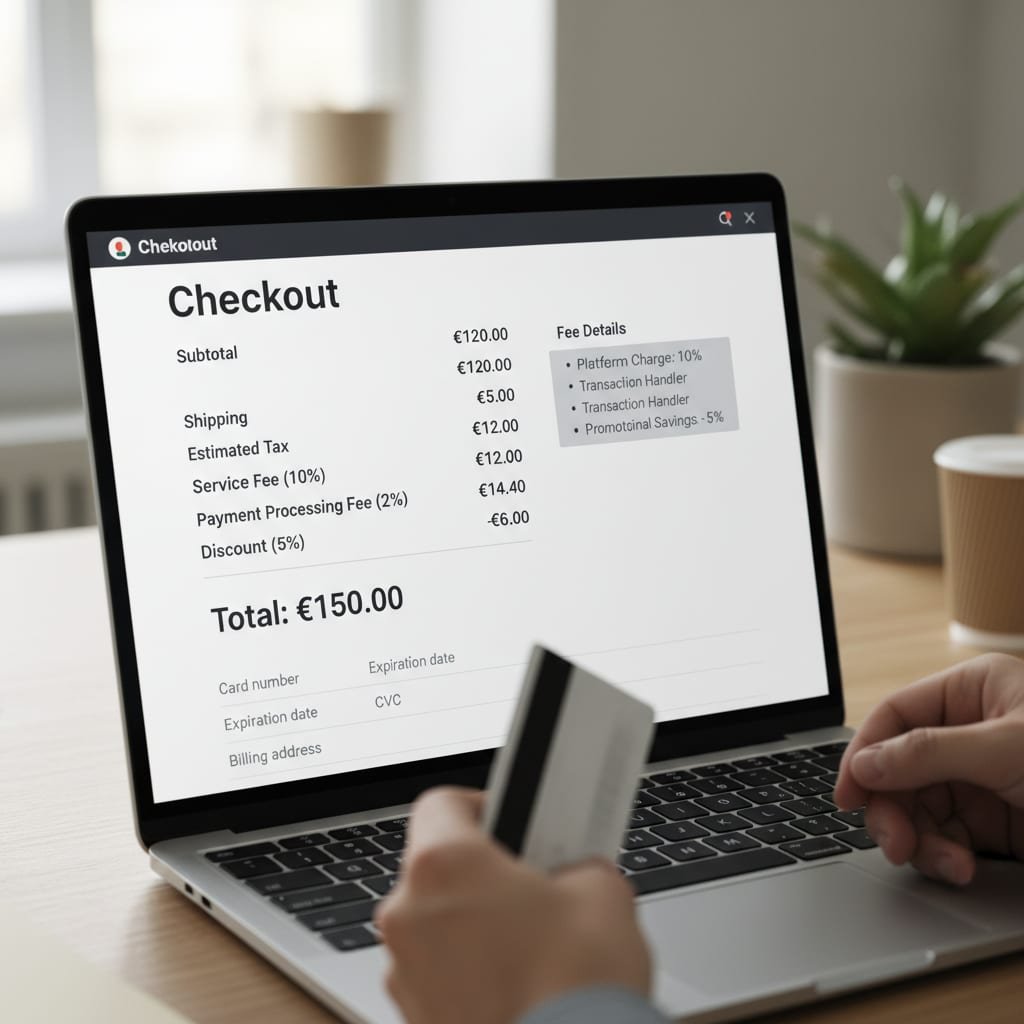
Gumroad fees come down to two numbers: 10% plus 50 cents on every sale you make directly, and 30% if a buyer finds you through Gumroad's Discover marketplace. The distinction that matters is whether you're paying for payment processing or paying for traffic — bundling both into one commission is what makes Gumroad expensive for anyone selling in volume, not for someone making a handful of sales a month.
TL;DR:
- Gumroad charges 10% + $0.50 per direct sale and 30% on anything sold through its Discover marketplace, with no monthly subscription fee.
- On a $10 sale, that flat 50-cent fee alone eats 15% of revenue — small transactions take the biggest percentage hit.
- Etsy's blended fee (listing + 6.5% transaction + processing) lands close to Gumroad's direct rate, but its marketplace exposure costs far less than Gumroad's 30% Discover cut.
- Gumroad's 2024 move to a flat 10% rate replaced a tiered structure that used to reward high-volume sellers with lower percentages — a real cost increase for top earners, not a simplification for everyone.
- A one-time checkout license typically pays for itself once lifetime sales cross roughly $4,000-4,500, after which every additional sale keeps the full margin instead of losing 10%.
Table of Contents
- Gumroad Fees, Broken Down: What You Actually Keep Per Sale
- Why People Are Leaving Gumroad (And Why Some Stay)
- Gumroad vs. Etsy: Which One Actually Costs Less
- Is Gumroad Worth It in 2026? The Volume Math That Settles It
- Is It Worth It to Sell on Gumroad At All?
- Gumroad Payment Methods, Login, and the Discover Marketplace
- Gumroad Alternatives Worth Comparing Before You Commit
- Keep the Full Sale Price: A Checkout You Own Instead of Rent
- Frequently Asked Questions
- Sources
Gumroad Fees, Broken Down: What You Actually Keep Per Sale

Gumroad's own pricing page lays out two rates, and the gap between them is the whole story. Sell directly — meaning you drove the traffic yourself, through email, social, or a link — and Gumroad takes 10% plus a flat 50 cents. Sell through Discover, Gumroad's internal marketplace where buyers find you through its own search and recommendations, and the cut jumps to 30%.
Ten percent plus fifty cents. That's the entire fee on a direct Gumroad sale — no tiers, no volume discount, no matter how much you've sold this year.
Here's what that looks like in actual dollars:
| Sale price | Direct fee (10% + $0.50) | You keep | Discover fee (30%) | You keep |
|---|---|---|---|---|
| $10 | $1.50 | $8.50 | $3.00 | $7.00 |
| $25 | $3.00 | $22.00 | $7.50 | $17.50 |
| $50 | $5.50 | $44.50 | $15.00 | $35.00 |
| $100 | $10.50 | $89.50 | $30.00 | $70.00 |
| $200 | $20.50 | $179.50 | $60.00 | $140.00 |
Notice the small-ticket problem: on a $10 sale, the flat 50-cent piece alone adds 5 percentage points on top of the 10%, pushing your real cut to 15%. That flat fee barely registers on a $200 sale but quietly wrecks the margins on cheap digital products, presets, and templates — the exact catalog a lot of Gumroad sellers run.
Pro Tip: If most of your catalog sits under $15, bundle products into a single $30-50 package instead of selling them separately. You'll pay Gumroad's flat 50-cent fee once instead of three or four times, which can recover several points of margin without changing anything else about your funnel.
Why People Are Leaving Gumroad (And Why Some Stay)

The most common complaint on r/ecommerce and similar seller forums isn't that Gumroad's fees are high in isolation — it's that they used to be lower for anyone who sold consistently, and now they aren't. Before 2024, Gumroad ran a tiered structure: new sellers paid around 9% plus 30 cents, and the rate dropped as lifetime sales climbed, down toward 2.9% plus 30 cents for top earners. The flat 10% + 50 cents that replaced it reads like a simplification, but for anyone who had built up volume under the old tiers, it was a straightforward rate increase.
That's the detail most comparisons miss: Gumroad didn't get more expensive for beginners. It got more expensive for the sellers who'd stuck around and scaled.
People who stay usually cite one thing — Discover traffic. For a seller with no existing audience, giving up 30% of a sale that wouldn't have happened otherwise is a defensible trade. The math only turns bad once you have your own audience and are still paying a percentage for sales Gumroad had nothing to do with generating.
Gumroad vs. Etsy: Which One Actually Costs Less

Which is better, Etsy or Gumroad, depends entirely on what you're selling and where your buyers come from. For digital products backed by your own audience — an email list, a following, a newsletter — Gumroad's direct fee structure is simpler to reason about. For handmade goods, printables, or anything that benefits from marketplace search discovery, Etsy's built-in traffic tends to convert better per dollar of fees paid.
| Fee component | Gumroad (direct) | Etsy (U.S.) |
|---|---|---|
| Listing fee | None | $0.20 per listing |
| Marketplace/transaction fee | 10% (or 30% via Discover) | 6.5% |
| Payment processing | Included in the 10% | ~3% + $0.25 |
| Effective cost on a $50 sale | $5.50 (11%) |
Run the numbers on a straightforward $50 sale, and Gumroad's direct rate and Etsy's blended rate land within a few cents of each other. The real difference shows up at the marketplace layer: Etsy's search-driven exposure costs a 6.5% transaction fee, while Gumroad's equivalent — Discover — costs 30%. If your business depends on marketplace search traffic rather than your own following, Etsy's fee structure is meaningfully cheaper for that traffic. If you're bringing your own buyers, neither marketplace fee applies to you, and the comparison comes down to processing cost alone.
Is Gumroad Worth It in 2026? The Volume Math That Settles It
Is Gumroad worth it in 2026 comes down to one question: how much are you selling, and is it growing? At low volume — a handful of sales a month, testing a product idea, no dedicated audience yet — Gumroad remains a reasonable starting point. There's no monthly fee, setup takes minutes, and you only pay when a sale actually happens.
The math changes once volume grows. A self-hosted checkout that charges a one-time license fee instead of a percentage becomes cheaper the moment your total processed sales cross a fixed threshold — after that point, you're saving the full percentage on every additional dollar.
$299 once, or 10% forever. Cross roughly $4,300 in lifetime sales, and a one-time checkout license has already paid for itself against Gumroad's direct fee.
If you're doing under a few thousand dollars a month and don't expect that to change soon, Gumroad's simplicity is worth the percentage. If you're past that and growing, the percentage is now the biggest line item in your cost structure, and it never stops recurring.
Is It Worth It to Sell on Gumroad At All?
Yes, if you're early — pre-audience, pre-revenue, still figuring out whether a product sells at all. Gumroad's free-to-start model (no monthly fee, no setup cost, you only pay per transaction) removes the risk of committing money before you have proof a product works. It's also worth noting Gumroad charges nothing monthly regardless of volume; the entire cost structure is transaction-based, which is exactly why it feels cheap at low volume and expensive at high volume.
No, if you already have consistent monthly revenue and your own traffic. At that point you're handing over 10% of revenue you generated yourself, for a checkout page that a $299 one-time tool replaces. The merchant of record structure that platforms like Gumroad use — where they legally sit between you and the buyer — is convenient early on and expensive later, because you're paying for a liability shield you may not need once you understand your own tax and compliance obligations.
Gumroad Payment Methods, Login, and the Discover Marketplace
Gumroad processes card payments through Stripe on the back end and offers PayPal as an alternative at checkout for buyers who prefer it. There's no native cryptocurrency support — if you want to accept Bitcoin, Lightning, or stablecoins, you'll need a separate tool alongside or instead of Gumroad.
Login is unified for buyers and sellers through a single Gumroad account at gumroad.com — buyers use it to access purchased files and licenses, sellers use the same login for their dashboard and payout settings.
Discover, Gumroad's internal marketplace, works like a storefront inside a storefront: your product becomes searchable to Gumroad's broader user base, at the cost of the 30% fee instead of 10%. It's genuinely useful if you have zero existing audience. It's a bad deal the moment you have any traffic of your own, because you're paying marketplace rates for a sale you could have made directly.
Gumroad Alternatives Worth Comparing Before You Commit
A few categories worth knowing before you pick a platform:
- Marketplace-style checkout platforms like Lemon Squeezy and Paddle operate as a merchant of record, meaning they handle tax collection and remittance for you — convenient, but the fee usually lands in the same 5-10% range as Gumroad's direct rate.
- Marketplace platforms with their own audience, like Etsy, trade a lower transaction fee for a per-listing cost and less control over branding and checkout experience.
- Self-hosted checkout software, including tools like ReplaPay, charges a one-time license fee instead of a percentage, connecting directly to your own Stripe account so payouts land with you, not through an intermediary. Understanding what percentage Stripe actually takes per transaction matters here, because that's the only fee left once you're not also paying a marketplace on top of it.
The right choice depends on where you are: pre-audience and testing an idea, a marketplace platform's traffic is worth the cut. Established with recurring buyers, the percentage stops making sense.
Keep the Full Sale Price: A Checkout You Own Instead of Rent
ReplaPay is a self-hosted checkout license — $299 once — that connects straight to your own Stripe account and crypto wallet, so card and crypto payments (Bitcoin, Lightning, stablecoins) land directly with you instead of passing through a marketplace taking 10-30% off the top. It includes 12 months of updates and 30 days of setup support, plus a built-in Stripe fee calculator so you can see your real take-home before you switch. The honest limit: you're responsible for your own Stripe account setup and tax handling since there's no marketplace acting as merchant of record on your behalf — check the spec sheet, and if that trade-off doesn't fit your situation yet, staying on a marketplace platform a while longer is a legitimate call.
Frequently Asked Questions
Why are people leaving Gumroad?
The most common reason cited on seller forums is Gumroad's 2024 shift from a tiered fee structure to a flat 10% + $0.50 on every direct sale. Sellers who had built up volume under the old tiers, which dropped as low as 2.9% + $0.30 for top earners, saw their effective rate increase rather than decrease.
Which is better, Etsy or Gumroad?
For digital products sold to your own audience, Gumroad's direct fee is simpler and lands close to Etsy's blended rate on a typical sale. For products that rely on marketplace search traffic, Etsy is cheaper because its transaction fee is 6.5% versus Gumroad Discover's 30%.
Is Gumroad worth it in 2026?
It's worth it at low volume, since there's no monthly fee and setup is fast. Past a few thousand dollars a month in sales, the 10% direct fee typically costs more than a one-time checkout license would over the same period.
Is it worth it to sell on Gumroad?
Yes for testing a new product idea with no existing audience, since you only pay when a sale happens. No for sellers with consistent traffic of their own, where the percentage fee becomes the largest ongoing cost in the business.
Is Gumroad free to sell on?
Yes — there's no monthly subscription or listing fee to open a Gumroad store. The cost only appears per transaction, as the 10% + $0.50 direct fee or the 30% Discover fee.
What payment methods does Gumroad support?
Gumroad accepts card payments processed through Stripe and offers PayPal as an alternative at checkout. It does not support cryptocurrency payments natively.
Sources
- Gumroad Pricing | Gumroad
- Gumroad Fees | Gumroad Help Center
- Etsy Seller Fees | Etsy
- Stripe Pricing | Stripe
- r/ecommerce discussion on Gumroad fees | Reddit