

Who has to collect sales tax and VAT when selling online depends on one question: who is the seller of record on the transaction. If you sell through your own checkout, the obligation is yours once you cross a state's economic nexus threshold or a country's registration threshold. If a marketplace or merchant of record sells on your behalf, the obligation is theirs. Foreign sellers of digital products often face a threshold of zero.
TL;DR:
- The legal obligation to collect sits with the seller of record. That is you, a marketplace facilitator, or a merchant of record, never your payment processor.
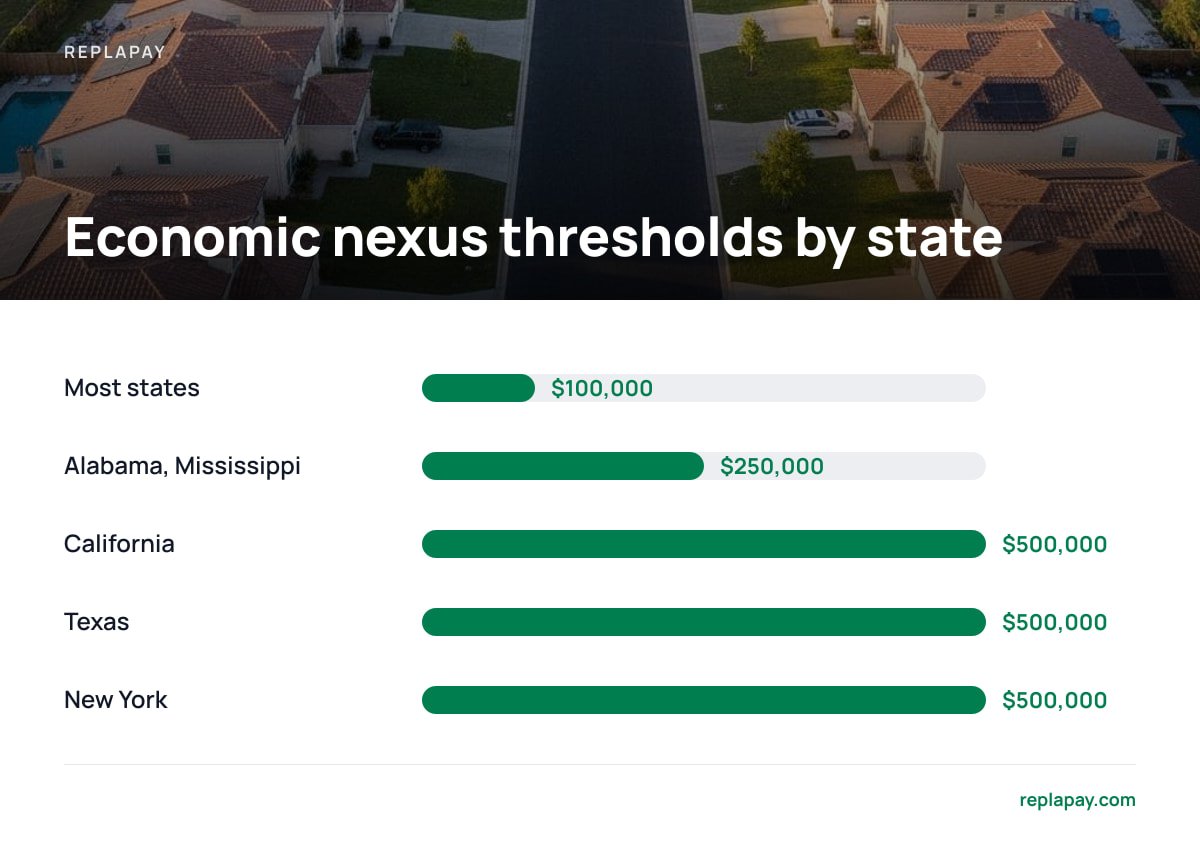
- In the US, most states require collection after $100,000 in annual sales into that state. California, Texas, and New York set the bar at $500,000.
- Alaska, Delaware, Montana, New Hampshire, and Oregon have no statewide sales tax. Alaska still has local sales taxes that remote sellers can owe.
- A non-EU seller of digital services to EU consumers has no registration threshold. You owe VAT from the first euro, usually filed through the EU's One Stop Shop.
- Sales tax and income tax are separate. No sales volume exempts you from income tax, even if no platform ever sends you a 1099-K.
Table of Contents
- Who Has to Collect Sales Tax and VAT When Selling Online: The Seller-of-Record Rule
- US Sales Tax After Wayfair: The Dollar Thresholds That Trigger Collection
- Why a ZIP Code Can't Tell You the Tax Rate
- VAT and GST Abroad: Where the Threshold for Foreign Sellers Is Zero
- Do You Pay VAT on All Sales? Four Cases Where You Don't
- How Much Can You Sell Online Without Paying Tax in 2026?
- Marketplace, Merchant of Record, or Your Own Checkout: Who Should Carry the Liability
- Keep the 5–13% and Handle Tax on Your Own Terms
- Frequently Asked Questions
- Sources
Who Has to Collect Sales Tax and VAT When Selling Online: The Seller-of-Record Rule

Every sales tax and VAT system puts the collection duty on the party legally making the sale. That party is the seller of record. Your payment processor is not the seller of record. Stripe moves the money, but it does not become the seller. On any online sale, one of three parties carries the obligation:
- You, selling through your own checkout. Your business name is on the receipt, so you register, collect, file, and remit in every jurisdiction where you have an obligation.
- A marketplace facilitator. Every US state with a sales tax now has a marketplace facilitator law. If you sell through a qualifying marketplace, the marketplace collects and remits on those sales.
- A merchant of record. A reseller buys your product and resells it to the customer. It becomes the legal seller and takes on the tax liability. If that model is new to you, read what a merchant of record is, explained in plain terms.
This is the distinction most guides skip. "Do I have to collect sales tax?" has no single answer for a business. It has one answer per sales channel. A seller with a marketplace storefront and a direct checkout can owe nothing on the first and a lot on the second.
US Sales Tax After Wayfair: The Dollar Thresholds That Trigger Collection
Before 2018, a state could only make you collect sales tax if you had a physical presence there, such as an office, employees, or inventory. The US Supreme Court's decision in South Dakota v. Wayfair overturned that rule on June 21, 2018. It allowed states to impose "economic nexus," which means a collection duty based on sales volume alone.
Every state with a sales tax adopted economic nexus within a few years. The most common threshold copies South Dakota's original law: $100,000 in sales into the state, or 200 separate transactions. A growing number of states have dropped the transaction count, including South Dakota itself. The trend is toward dollar-only thresholds.
| State | Economic nexus threshold | Note |
|---|---|---|
| Most states | $100,000 in annual sales | Some still add a 200-transaction alternative |
| California | $500,000 | Highest-population state, one of the highest bars |
| Texas | $500,000 | Measured on total revenue into Texas |
| New York | $500,000 and more than 100 transactions | You must meet both tests |
| Alabama, Mississippi | $250,000 | Middle tier |
| Alaska, Delaware, Montana, New Hampshire, Oregon | No statewide sales tax | Alaska localities still tax remote sales |
Two details change the math more than most sellers expect:
- What counts toward the threshold varies. Some states count gross sales, including exempt and marketplace sales. Others count only taxable retail sales. A seller of exempt digital downloads may cross $100,000 in one state and owe nothing, while the same sales trigger registration in another state.
- Physical presence still counts. One contractor, one storage unit, or one trade-show booth can create nexus at $0 in sales. Wayfair added a way to owe tax. It did not remove the old one.
$100,000 into a single state, not $100,000 total. A seller doing $2 million a year spread evenly across 45 states has economic nexus almost nowhere.
What States Don't Tax Online Sales?
Five states have no statewide sales tax: Alaska, Delaware, Montana, New Hampshire, and Oregon. In four of them, online sales to customers in that state carry no sales tax at all. Alaska is the exception. Many Alaskan cities and boroughs levy their own local sales taxes, and a group of them collect from remote sellers through a shared commission. "Alaska has no sales tax" is true at the state level and wrong at the checkout level.
Beyond those five, many states don't tax certain kinds of online sales. Digital downloads, software-as-a-service, and online courses are taxed differently from state to state. For example, California generally does not tax electronically delivered digital products, while other states tax some or all of them. Check taxability for your specific product before you assume a threshold applies to you.
Why a ZIP Code Can't Tell You the Tax Rate
US sales tax is charged at the rate where the customer receives the product. That rate stacks state, county, city, and special district taxes. ZIP codes were designed to route mail, not to mark tax boundaries. One ZIP code can span several tax jurisdictions with different rates.
What Is the Sales Tax Rate for ZIP Code 93636?
ZIP code 93636 covers part of Madera County, California, including the Madera Ranchos area. Every sale delivered there starts at California's 7.25% statewide base rate. The final rate is higher because Madera County district taxes are added on top. Because district taxes depend on the exact address, not the ZIP code, confirm the current rate with the California Department of Tax and Fee Administration's rate lookup before you hard-code anything.
That's the general lesson. If your tax setup uses a ZIP-to-rate table, it will sometimes be wrong. Address-level rate lookup is the standard that holds up in an audit.
VAT and GST Abroad: Where the Threshold for Foreign Sellers Is Zero

US sales tax rewards small sellers with generous thresholds. VAT systems often do the opposite for foreign businesses. They want the tax from your first sale, because a seller outside the country is harder to chase later.
| Jurisdiction | Who must register | Threshold for a foreign seller |
|---|---|---|
| European Union | Non-EU sellers of digital services to EU consumers | €0, registration from the first sale |
| European Union | EU-based sellers making cross-border B2C sales | €10,000 EU-wide before destination-country VAT applies |
| United Kingdom | Overseas sellers of digital services to UK consumers | £0 for non-UK-established businesses |
| Australia | Non-residents selling digital products to Australian consumers | A$75,000 annual GST turnover |
| Canada | Non-residents selling digital products to Canadian consumers | C$30,000 over 12 months (simplified GST/HST) |
€0. That is the EU VAT registration threshold for a US creator selling an ebook, a plugin, or a course to a consumer in France.
The European Union
Since July 1, 2021, a non-EU business selling digital services to EU consumers has had to charge VAT at the customer's country rate from the first sale. Rates range from 17% in Luxembourg to 27% in Hungary. You don't need 27 separate registrations. The EU's One Stop Shop lets you register in one member state and file a single quarterly return covering all of them. For physical goods shipped into the EU in consignments worth €150 or less, the Import One Stop Shop works the same way. You collect VAT at checkout instead of making your customer pay at the border.
The United Kingdom
The UK's £90,000 VAT threshold applies only to businesses established in the UK. HMRC's registration rules set no threshold for businesses established outside the UK. A US seller of digital services to UK consumers registers from the first sale. For physical goods, sellers collect UK VAT at the point of sale on consignments worth £135 or less.
Do You Pay VAT on All Sales? Four Cases Where You Don't
No. Even if you are registered, several kinds of sales carry no VAT, or put the VAT on someone else.
- Business customers (B2B). When an EU business customer gives you a valid VAT number, you usually charge 0% and note "reverse charge" on the invoice. The customer accounts for the VAT in their own return. Check the number in the EU's VIES database before you zero-rate the sale.
- Exports. Goods shipped out of the VAT territory are generally zero-rated by the seller. The customer may pay import VAT on arrival instead.
- Below-threshold sales. Where a threshold exists for you, such as A$75,000 in Australia or C$30,000 in Canada, sales below it carry no collection duty.
- Exempt or reduced-rate items. Many countries exempt or reduce the rate on items like ebooks, educational services, or medical goods. Rates differ by country even within the EU.
Reverse charge matters most if you sell software. If 70% of your EU revenue comes from businesses with valid VAT numbers, only the other 30% runs through your OSS return. That changes how much compliance work you actually take on.
Pro Tip: For EU digital sales, record two pieces of location evidence for every transaction, such as the billing country and the card's issuing country. Your checkout already captures both. When they conflict, that sale is the one an auditor will ask about. OSS records must be kept for 10 years, so store this evidence in your own database, not only in your processor's dashboard.
How Much Can You Sell Online Without Paying Tax in 2026?
This question mixes up two different taxes, and the answers differ.
Sales tax and VAT: The thresholds above set how much you can sell before you must collect. In most US states that is $100,000 per state per year, and $500,000 in California, Texas, and New York. For digital sales into the EU or UK from abroad, it is zero.
Income tax: In the US, no sales threshold exempts you from income tax. All profit is reportable. People get confused by Form 1099-K, which payment platforms send to sellers. The IRS guidance on Form 1099-K explains that the reporting threshold returned to $20,000 and 200 transactions under 2025 federal legislation. That threshold decides whether you receive a form. It does not decide whether you owe tax. A seller who makes $15,000 in profit and receives no 1099-K still owes income tax on all $15,000.
Marketplace, Merchant of Record, or Your Own Checkout: Who Should Carry the Liability
This is the trade-off nobody quotes in dollars. A merchant of record typically charges 5–13% of each sale, and part of that fee pays for tax handling. On $150,000 a year, an 8% cut is $12,000. The question is whether your actual tax exposure costs more than that to handle yourself. We break this down in merchant of record tax liability explained with real numbers.
Here is our position. If you are US-based, your sales are mostly domestic, and you are under $100,000 in every state except your home state, a merchant of record is mostly expensive insurance. You probably have one sales tax registration, possibly none if your product is exempt in your state. Paying 5–13% of all revenue to avoid that is a poor trade.
The answer flips in one case: a non-US or US seller with heavy B2C digital sales into the EU and UK who does not want to file quarterly returns. The zero thresholds mean registration from the first sale, and the OSS filing never stops. Some sellers will reasonably pay to avoid that. Even then, do the math. One OSS registration plus four filings a year often costs far less than a percentage of every sale. Payment-side tools like Stripe Tax can calculate rates at checkout for a per-transaction fee, without making anyone else the seller.
If you're comparing options, our breakdown of Gumroad alternatives without commission covers what changes when you move from a platform that acts as seller to one that doesn't.
Keep the 5–13% and Handle Tax on Your Own Terms

ReplaPay is self-hosted checkout software that sends card payments straight into your own Stripe account and crypto payments, including Bitcoin, Lightning, and stablecoins, into your own wallet. It costs a one-time $299 license instead of a percentage of every sale. That price includes 12 months of updates and 30 days of setup support. For the seller described above, with mostly domestic sales under state thresholds, the license pays for itself on the first few thousand dollars of revenue it doesn't take a cut from.
The honest limit: ReplaPay does not become your merchant of record, and it does not file your taxes. With your own checkout, you are the seller, and the registrations and returns in this article are your responsibility. Turn on Stripe Tax or work with an accountant if you have EU or UK digital sales. Check your exposure before you switch, not after.
Frequently Asked Questions
Do I have to collect sales tax if I sell online from outside the US?
Yes, if you cross a state's economic nexus threshold. Wayfair-era nexus is based on sales into the state, not where your business is located. Most states set that threshold at $100,000 in annual sales, while California, Texas, and New York use $500,000.
Does Stripe collect sales tax or VAT for me?
Not by default, because Stripe is a payment processor, not the seller of record. Its optional Stripe Tax product can calculate and collect the right tax at checkout for a fee. Registering and filing returns remain your responsibility.
What states don't tax online sales?
Alaska, Delaware, Montana, New Hampshire, and Oregon have no statewide sales tax. Alaska is the exception in practice, because many of its cities and boroughs levy local sales taxes that remote sellers may have to collect.
Do I have to charge VAT to EU customers if I'm a small US seller?
For digital services sold to EU consumers, yes, from the first sale. The EU has no registration threshold for non-EU sellers. You can register once through the One Stop Shop and file a single quarterly return covering every member state.
Do I charge VAT to business customers in the EU?
Usually not, as long as the customer provides a valid VAT number that you verify in the EU's VIES database. You invoice at 0% under the reverse-charge rule, and the customer accounts for the VAT in their own return.
Sources
- California City and County Sales and Use Tax Rates | California Department of Tax and Fee Administration
- VAT One Stop Shop | European Commission
- Register for VAT | HM Revenue & Customs (GOV.UK)
- Understanding Your Form 1099-K | Internal Revenue Service