

A merchant of record, explained simply, is the business or entity legally and financially responsible for a sale — the name on the customer's card statement, and the party liable for sales tax, chargebacks, and refunds. That's a different job from a payment processor, which just moves the money. Sell through a marketplace-style platform and the platform is usually your merchant of record; run your own Stripe account and that responsibility sits with you.
TL;DR:
- A merchant of record is the legal entity liable for a sale, not just the company that routes the payment.
- Platforms like Gumroad and Paddle act as merchant of record for you, which is why their name shows up on your customer's card statement instead of yours.
- Your own Stripe or merchant account makes you the merchant of record, which means more paperwork but you keep the full margin on every sale.
- PCI DSS compliance tiers, set by the card networks, determine how much underwriting scrutiny a new merchant account faces.
- Expense mismatches ("I don't remember buying this") usually trace back to a merchant of record whose name doesn't match the seller you actually bought from.
Table of Contents
- Merchant of Record, Explained: Who's Actually on the Hook for the Sale
- Merchant of Record vs. Payment Processor: Two Different Jobs, One Confusing Industry
- Why Your Bank Statement Says a Name You Don't Recognize
- What "Merchant" Means on an Expense Report (and Why It Confuses Finance Teams)
- The Real Cost of Letting Someone Else Be Your Merchant of Record
- Getting Your Own Merchant Account: Harder Than It Sounds, or Not?
- When a Merchant of Record Actually Makes Sense (and When It's Dead Weight)
- Own Your Checkout Without Becoming Your Own Legal Department
- Frequently Asked Questions
- Sources
Merchant of Record, Explained: Who's Actually on the Hook for the Sale
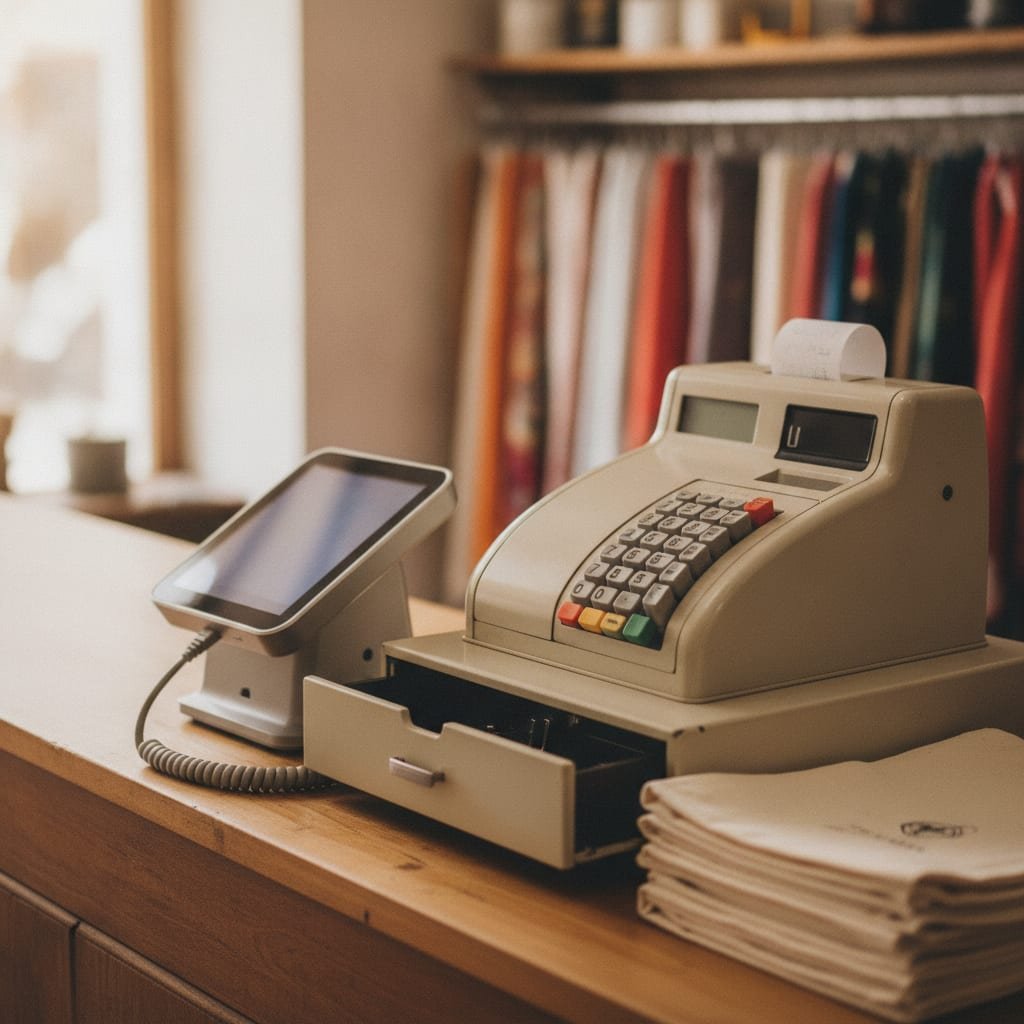
When you ask what a merchant of record is, you're really asking one question: who is legally responsible if this transaction goes wrong? Not who processes the card, not who built the checkout page — who eats the chargeback, who remits the sales tax, who shows up on the customer's bank statement. That entity is the merchant of record, and in most consumer transactions it is not the same company as the payment processor, even though the two get used interchangeably in casual conversation.
Here's the distinction that actually matters: a payment processor (Stripe, Square, Adyen) moves money and authorizes transactions. A merchant of record owns the transaction itself — the tax liability, the refund policy, the chargeback exposure, and the relationship with the card networks. When you buy a $40 ebook through a platform like Gumroad or Paddle, that platform is almost always the merchant of record. It collects your sales tax, issues your receipt, and its name — not the creator's — appears on your card statement. The creator never touches merchant-of-record responsibilities at all; the platform absorbs them in exchange for a cut of every sale, typically 5% to 13% depending on the platform and payment method.
If you instead run your own Stripe account and accept payments directly, you are the merchant of record. You're the one liable for chargebacks, you're the one responsible for sales tax collection in states or countries where you have obligations, and your business name is what shows up on the buyer's statement. For a deeper breakdown of how this split plays out with specific platforms, see Merchant of Record vs Payment Processor: What Actually Differs.
Merchant of Record vs. Payment Processor: Two Different Jobs, One Confusing Industry
The reason this gets muddled is that one company can hold both roles at once. Stripe, for example, can be your payment processor while you remain the merchant of record — or a platform built on top of Stripe can be both the processor's client and your merchant of record simultaneously. Here's how the roles break down in practice:
| Role | What it actually does | Who holds liability | Example |
|---|---|---|---|
| Merchant of record | Legally sells the product, collects tax, handles chargebacks | The seller named in the agreement | Gumroad, Paddle, Lemon Squeezy |
| Payment processor | Authorizes and moves the card transaction | Limited — follows card network rules | Stripe, Adyen, Square |
| Payment gateway | Encrypts and transmits payment data to the processor | None over the sale itself | Stripe Checkout, Braintree |
| You, with your own Stripe account | All of the above, under your own business | You | A direct Stripe integration |
Notice that "merchant of record" isn't a technology — it's a legal and financial position. A platform can swap its underlying payment processor without ever changing who the merchant of record is. That's also why switching from one marketplace-style platform to another rarely changes your tax or chargeback exposure: you're still not the merchant of record either way.
Why Your Bank Statement Says a Name You Don't Recognize

This is the most common real-world collision with the term, and it answers a question a lot of people search separately: how do you find out who your credit card processor actually is? You usually can't, directly — but you can find your merchant of record, and that's the more useful number anyway.
Every card charge carries a billing descriptor, a short text string the merchant of record sets, and it frequently doesn't match the storefront name you remember. The Federal Trade Commission notes that a large share of "I don't recognize this charge" disputes trace back to a mismatch between the seller's storefront name and the merchant of record's billing descriptor, not actual fraud. If you don't recognize a charge:
- Check the full descriptor, not just the first word. Statements often truncate to something like "PDL*CREATORNAME" — the "PDL" prefix is the platform's merchant code, and the name after it is the actual seller.
- Search the descriptor directly. Banks and card networks maintain descriptor lookup tools, and a web search of the exact string usually surfaces the platform within seconds.
- Call the number next to the charge. Most statements list a phone number tied to the merchant of record, not the processor — that's who can actually issue a refund.
- Ask your bank for the acquiring bank name, if the descriptor search fails. Your bank can see which acquiring bank settled the transaction, which narrows down the merchant of record even when the descriptor is cryptic.
A descriptor mismatch isn't a red flag by itself — it's just proof the merchant of record and the storefront you bought from are two different companies.
What "Merchant" Means on an Expense Report (and Why It Confuses Finance Teams)
In expense management, "merchant" is shorthand for whoever the card statement says you paid — which, again, is the merchant of record, not necessarily the company whose product you received. This causes real friction during expense reconciliation. An employee buys a $29/month subscription from a small SaaS tool; the statement shows a merchant name like "FastSpring" or "Paddle" instead of the software's actual name. Finance teams flag it as unrecognized, the employee has to dig up the receipt to prove the match, and the whole process adds friction for a $29 line item.
This is one of the quieter costs of selling through a merchant-of-record platform: it's not just your margin that shrinks, it's your buyer's experience that gets a little more confusing. A direct Stripe charge under your own business name doesn't have this problem, because the merchant of record and the brand the customer remembers are the same entity.
The Real Cost of Letting Someone Else Be Your Merchant of Record
Marketplace-style platforms take on merchant-of-record responsibilities — and that service isn't free. It's priced into the percentage they take off every sale, usually stacked on top of standard card processing fees. A 5% platform fee on top of roughly 3% in card processing costs means you're losing close to 8 cents of every dollar before you've paid for anything else. On higher-friction categories like digital goods sold internationally, that combined cut can run past 13%.
On $10,000 in monthly sales, an 8% effective cut is $800 a month — every month, forever, for as long as you keep using that platform.
That math is the entire argument for owning your own Stripe account instead. You can see exactly where those percentages land on your own numbers with the Stripe Payment Calculator, which breaks down what you actually net per sale after processing fees alone, with no platform markup layered on top.
Getting Your Own Merchant Account: Harder Than It Sounds, or Not?

This is the real trade-off, and it's worth answering honestly: how hard is it to get a merchant account? For most small sellers in 2024, the answer is "easier than people assume, but not instant." Signing up for a Stripe account takes minutes, but Stripe still runs underwriting in the background — reviewing your business type, expected volume, and risk category before fully activating features like payouts to your bank. Higher-risk categories (subscriptions, digital downloads sold internationally, adult content, crypto-adjacent businesses) get more scrutiny and sometimes manual review that takes a few business days.
Underwriting scrutiny generally follows transaction volume. The PCI Security Standards Council and the card networks define compliance tiers based on how many transactions a merchant processes annually:
| Level | Annual transaction volume | Typical requirement |
|---|---|---|
| Level 1 | Over 6 million | Annual on-site security audit |
| Level 2 | 1–6 million | Annual self-assessment questionnaire |
| Level 3 | 20,000–1 million (e-commerce) | Annual self-assessment questionnaire |
| Level 4 | Under 20,000 (e-commerce) | Annual self-assessment, lighter requirements |
Nearly every independent creator and small seller sits in Level 4, which means the compliance burden is genuinely light — a self-assessment questionnaire, not an audit. Visa's merchant compliance program outlines these same tiers and is a useful reference if you want to check where your volume actually lands before assuming the process is harder than it is.
Pro Tip: Before you apply for or activate a Stripe account under a new business entity, register for an Employer Identification Number first, even if you're a sole proprietor. Underwriting reviews move noticeably faster when your business name, tax ID, and bank account all match on the first submission — resubmissions after a mismatch can add several days to activation.
When a Merchant of Record Actually Makes Sense (and When It's Dead Weight)
A merchant-of-record platform earns its cut in specific situations: you're selling into dozens of countries and don't want to register for VAT or GST in each one, you're pre-revenue and can't justify any setup time, or your volume is small enough that a percentage fee costs less in absolute dollars than the hours it would take to manage tax compliance yourself. For someone doing $500 a month in sales, an 8% cut is $40 — cheaper than a bookkeeper's hourly rate.
The math flips once volume grows. At $10,000 a month, that same percentage is a car payment. At that point, most sellers already know their main markets, already understand their tax obligations in them, and are paying a recurring fee for a convenience they no longer need at that scale. That's the exact audience that benefits from owning a direct Stripe integration instead of a marketplace-style checkout — and if you're also fielding requests to accept crypto, How to Accept Bitcoin Payments on Your Website covers the direct-wallet alternative to routing crypto through a third party too.
Own Your Checkout Without Becoming Your Own Legal Department
If the math in this article landed on your business — meaningful volume, a platform taking 5% to 13%, and tax obligations you already understand — ReplaPay is built for exactly that gap. It's a self-hosted checkout license, a one-time $299 fee instead of a recurring cut, that connects payment links directly to your own Stripe account and crypto wallet, including Bitcoin, Lightning, and stablecoins. You become the merchant of record on your own terms, keep the full margin on every sale, and the license includes 12 months of updates plus 30 days of setup support.
The honest caveat: you still take on the responsibilities that come with being merchant of record yourself, including sales tax registration where it applies, so check the spec sheet before switching if you're currently relying on a platform's built-in tax handling across many countries. For sellers mostly serving one or two markets already, that trade is usually worth it; for sellers spread across thirty countries, weigh it first. If payment links without a full storefront are more your situation, Create a Payment Link Without a Website in 5 Minutes walks through the lighter-weight version of the same idea.
Frequently Asked Questions
What is a merchant of record, in one sentence?
It's the legal entity responsible for a sale — liable for chargebacks, sales tax, and refunds — and whose name appears on the customer's card statement, as distinct from whatever company merely processes the payment behind the scenes.
How do I find out who my credit card processor is?
You typically can't identify the processor directly from a statement, but you can identify the merchant of record by reading the full billing descriptor, searching that exact string online, or calling the phone number listed next to the charge.
What does "merchant" mean when doing expenses?
On an expense report, "merchant" refers to whichever name the card statement shows for a purchase, which is the merchant of record rather than the brand you actually bought from — a common source of reconciliation confusion with subscription tools sold through third-party platforms.
How hard is it to get a merchant account?
For most small sellers, setting up a basic account with a processor like Stripe takes minutes, though full activation can take a few business days while underwriting reviews your business type and expected volume; higher-risk categories face more scrutiny.
Is a payment processor the same as a merchant of record?
No. A payment processor authorizes and moves the money for a transaction, while a merchant of record holds the legal and financial responsibility for the sale, including tax collection and chargeback liability — one company can hold both roles, or two separate companies can split them.
Sources
- PCI Security Standards Council | PCI Security Standards Council
- Visa Merchant Compliance Program | Visa
- Understanding Your Form 1099-K | Internal Revenue Service
- Disputing Charges and Unauthorized Transactions | Federal Trade Commission