

Does a merchant of record accept high risk products? Usually not. A merchant of record becomes the legal seller of your product, so it absorbs your refunds, chargebacks and regulatory exposure. A payment processor only moves money and can price risk into a reserve. Mid-risk sellers such as subscriptions, courses and software can often get in after review. Adult content, gambling, supplements and get-rich offers almost never do.
TL;DR:
- A merchant of record is the legal seller, so its banned-products list is stricter than a processor's.
- Adult, gambling, counterfeit, get-rich offers and most supplements are refused outright. Subscriptions, courses and software are reviewed case by case.
- Your chargeback rate, refund window and delivery lag can mark you high risk even when your product looks harmless.
- Leaving for your own Stripe account does not remove the product ban. Stripe keeps its own restricted list.
- A one-time-fee checkout beats a 5% to 10% marketplace cut after roughly 80 to 240 sales of $50, but you take on tax and compliance yourself.
Table of Contents
- Why a Merchant of Record Says No More Often Than a Processor Does
- Which Products Count as High Risk, and Where the Lines Fall
- Are You a High-Risk Merchant? Four Signals Reviewers Check
- Does a Merchant of Record Accept High-Risk Products? What Actually Happens at Review
- Why a Top-10 Processor List Won't Fix a Rejection
- What To Do After a Rejection: Four Routes, Ranked
- The Math When You Leave a Merchant of Record
- Get a Checkout You Own When a Merchant of Record Turns You Down
- Frequently Asked Questions
- Sources
Why a Merchant of Record Says No More Often Than a Processor Does
A merchant of record (MoR) is the entity that legally sells your product to the buyer, which means it carries the tax filing, the refund and the dispute. The main guide on what a merchant of record is covers the full definition and the ownership argument. For this article, one consequence matters: the MoR's name is on the receipt.
A processor can decline a category, charge you more, or hold a reserve against it. A MoR cannot hand the liability back to you, because in the buyer's eyes it sold the item. If your customer disputes a $79 charge, the MoR pays the dispute fee and takes the hit with its own card-network sponsor. If your product turns out to be illegal in a buyer's country, the MoR is the party a regulator contacts.
So the pattern across these platforms is consistent. The acceptable-use page is longer than the processor's, approval is manual for anything borderline, and the platform keeps the right to freeze payouts while it investigates.
Which Products Count as High Risk, and Where the Lines Fall

"High risk" is not a legal category. It is the underwriting view that a product produces more chargebacks, more fraud, or more regulatory trouble than average. Here is how that usually plays out at a MoR:
| Tier | Typical products | Typical MoR response |
|---|---|---|
| Refused outright | Adult content, gambling, counterfeit goods, drugs and paraphernalia, multi-level marketing, forex or investment signals, virtual currency exchange | Rejected at application, or account closed after launch |
| Reviewed manually | Supplements, CBD, "make money online" courses, dating products, nutrition or fitness plans with health claims, trial-to-paid subscriptions | Approved with conditions, rejected, or approved then reviewed again after volume grows |
| Usually accepted | Software, templates, ebooks, design assets, music samples, standard online courses, SaaS with clear cancellation | Approved, sometimes with a delivery or refund policy check |
For the first row, the same categories appear on Stripe's list of prohibited and restricted businesses, which names adult content and services, gambling, counterfeit goods, multi-level marketing, and get-rich-quick or investment schemes. A MoR sits on top of a processor like this, so its list is at least that long.
The middle row is where most of the disagreement comes from. Two platforms will rule differently on the same supplement store. Read each provider's acceptable-use page, because CBD, supplements and income-claim courses show up on many of them, and the wording on "claims" often decides the outcome.
Are You a High-Risk Merchant? Four Signals Reviewers Check
You may already be one without selling anything on the table above. Reviewers score the business as much as the product. These signals push a normal seller into the manual-review pile:
- Chargeback ratio. Disputes divided by transactions. Most card-network monitoring programs start flagging sellers once disputes reach about 1% of sales, so a store at 0.6% has little room before review.
- Delivery lag. If the buyer pays now and receives the product weeks later (pre-orders, cohort courses, custom work), the window for a dispute stays open longer.
- Refund and cancellation friction. A buyer who cannot cancel easily disputes the charge with the bank instead. Hidden trial conversions are the usual culprit.
- Income or health claims. "Earn $10,000 a month" or "cures anxiety" on a sales page moves a template seller into a regulated category.
You can check your own numbers before anyone asks. Pull the last 90 days of disputes and divide by transactions. Stripe's dispute documentation explains how disputes are counted and what a seller can submit as evidence.
Does a Merchant of Record Accept High-Risk Products? What Actually Happens at Review
Review has three outcomes, and only one of them is a clean yes.
A clean no at application. If your product sits in the refused tier, you get a templated rejection, often with no appeal. This costs you a week at most.
A conditional yes. Mid-risk sellers are approved with limits: a lower payout ceiling, a rolling reserve, a longer payout delay, or a required refund policy. Read these terms before you sign, because the reserve percentage and release schedule change your cash flow more than the headline fee does. Our checklist of merchant of record contract terms to check lists the clauses worth reading line by line.
A yes that becomes a no. This is the expensive outcome. You are approved as a "digital product" seller, your catalog drifts toward a restricted category, and the platform freezes payouts mid-month. Because the MoR collected the money as the seller, your balance sits with them while they investigate.
I would not build a business on a conditional yes. A platform that can reclassify you after launch holds your cash flow hostage in a way a processor account does not.
Why a Top-10 Processor List Won't Fix a Rejection
Many "top 10 payment processors" lists answer a different question. A ranking built on fees, countries and uptime tells you who is largest. It says nothing about whether your category will be approved, because acceptance depends on three layers:
- The card networks. Visa and Mastercard set rules that every provider below them must follow.
- The acquiring bank. The bank behind the processor sets its own appetite, which is why one gateway takes a category that another refuses.
- The platform's own policy. A MoR adds a layer on top of both.
If a list sends you to a "high-risk processor," look at the trade. Specialist high-risk accounts commonly come with rolling reserves, higher per-transaction rates and long contracts. Compare that quote with the fee you were trying to escape before you sign. Sometimes the specialist costs more than the MoR that rejected you.
What To Do After a Rejection: Four Routes, Ranked
1. Fix the cause if it is fixable
If you were rejected over a claim on your sales page, a missing refund policy or a vague cancellation flow, rewrite it and reapply. This is the cheapest route, and it works more often than sellers expect, because many rejections come down to presentation.
2. Use your own Stripe account for mid-risk categories
If you sell courses, software or subscriptions that a MoR found too fiddly, a direct Stripe account is the route I would pick first. You become the seller, so you handle tax and disputes yourself, but you answer to one underwriter instead of two. Stripe's standard US card rate of 2.9% plus 30 cents is the figure to use when modeling this.
3. Accept crypto directly for sales a card network will not touch
Bitcoin, Lightning and stablecoin payments into your own wallet need no underwriting approval. They also come with no chargebacks, the risk that scares MoRs most. The legal duties remain yours: FATF's virtual asset guidance targets businesses that exchange, transfer or custody crypto for others, and taking payment for your own goods into your own wallet generally sits outside that definition. Confirm with a lawyer in your jurisdiction, because the regulator decides, not the software.
4. A specialist high-risk processor, as the last resort
Choose this only if your category is legal but refused by mainstream providers. Price the reserve, the contract length and the exit fee before you compare headline rates.
If your product is in the refused tier because it is illegal or deceptive, no route above is a loophole. Do not misdescribe the product to get through review. Providers check, and misdescription is the fastest way to a frozen balance.
Pro Tip: Before you apply anywhere, assemble a one-page evidence packet: your 90-day dispute rate, your refund policy, a screenshot of your cancellation flow, and a short statement of what the buyer receives and when. Reviewers decide borderline cases in minutes, and a seller who hands over the data they were about to request tends to get a decision faster, and a less severe one.
The Math When You Leave a Merchant of Record
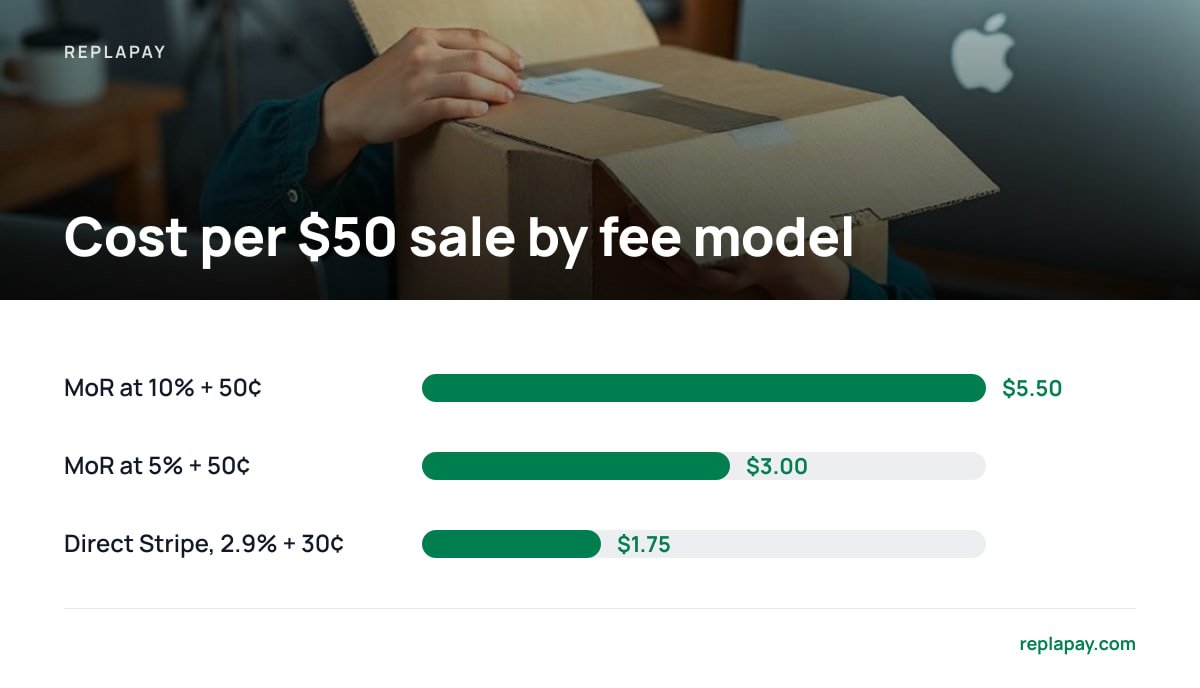
Leaving a MoR trades fee for workload, so run the numbers first. This table compares a hypothetical marketplace-style MoR fee against direct Stripe card processing on a $50 sale, with a one-time $299 license for self-hosted checkout:
| Fee model | Cost per $50 sale | Savings per sale vs. direct | Sales to recover $299 |
|---|---|---|---|
| MoR at 5% + 50¢ | $3.00 | $1.25 | about 240 sales ($12,000) |
| MoR at 10% + 50¢ | $5.50 | $3.75 | about 80 sales ($4,000) |
| Direct Stripe, 2.9% + 30¢ | $1.75 | n/a | n/a |
At a 10% MoR fee, a $299 one-time license pays for itself in about 80 sales of $50.
Two caveats apply. Stripe adds fees for international cards and currency conversion, so your real rate may be higher. And once you stop using a MoR, you collect and remit sales tax or VAT yourself, or pay an accountant to. If you want to know what your platform fee really leaves you, our breakdown of what a marketplace fee actually takes per sale shows the arithmetic. For the direct route against a MoR in general, the cost comparison with direct Stripe covers it.
Get a Checkout You Own When a Merchant of Record Turns You Down
ReplaPay is a self-hosted checkout license for a one-time $299. Payments go straight into your own Stripe account and your own crypto wallet (Bitcoin, Lightning and stablecoins), with payment links for both. That fits the seller in this article: your product got a "no" or a "maybe" from a MoR, you want to stop paying 5% to 13% of every sale, and you would rather have one underwriter, Stripe, than two. The license includes 12 months of updates and 30 days of setup support, and a free Stripe fee calculator on the site lets you run your own break-even before you buy.
Weigh the limit most. ReplaPay does not change what Stripe will approve. If your product is on Stripe's restricted list, a self-hosted checkout will not get you around it, and you also become responsible for sales tax, VAT and disputes. Check your category against Stripe's list first. If it passes, the software gives you the checkout. If it does not, crypto direct to your wallet is the only part of the product that helps, and you should confirm the legal side before relying on it.
Frequently Asked Questions
Does a merchant of record accept high risk products?
Usually not for truly high-risk categories. Adult content, gambling, counterfeit goods, multi-level marketing and investment or forex offers are generally refused, because the merchant of record is the legal seller and absorbs the liability. Mid-risk products such as courses, subscriptions and some supplements get manual review and may be approved with conditions.
What does it mean to be the merchant of record?
The merchant of record is the business that legally sells the product to the buyer, appears on the receipt and handles taxes, refunds and chargebacks. That is why it screens products more strictly than a payment processor does. The main guide on this site covers the full definition.
Which products or services would be considered higher risk?
Products with high dispute rates, regulatory exposure or fraud potential. That includes adult content, gambling, supplements and CBD, income-claim courses, forex or investment signals, dating services, and subscriptions with trial-to-paid conversions. A long delivery delay can also push a normal product into review.
How do I know if I am a high-risk merchant?
Check your chargeback ratio over the last 90 days, how long buyers wait to receive the product, how easy cancellation is, and whether your sales page makes income or health claims. Dispute ratios near 1% of transactions commonly trigger card-network monitoring, so a seller close to that line has little margin.
Who are the top 10 payment processors?
A top-10 list ranks size and fees, and it does not predict whether your category will be approved. Approval depends on the card networks, the acquiring bank and the platform's own policy. Compare providers by their acceptable-use page and reserve terms for your product, then price the fees.
Can I avoid a rejection by accepting crypto instead?
Crypto paid directly into your own wallet needs no underwriting approval and has no chargebacks, so it works for sales a card network would refuse. Your legal duties still apply, including local licensing and tax rules, so confirm them with a lawyer in your jurisdiction.
Sources
- Prohibited and restricted businesses | Stripe
- Disputes documentation | Stripe
- Pricing and fees | Stripe
- Virtual assets | Financial Action Task Force (FATF)