

A merchant of record is the legal entity that takes responsibility for a sale — collecting the payment, remitting sales tax or VAT, and answering chargebacks — not the company that merely processes the card. The distinction that matters is between who moves your money (a payment processor like Stripe) and who legally owns the transaction and its tax liability (a marketplace-style merchant of record like Paddle or Lemon Squeezy). Confusing the two is how sellers end up surprised by a 5-10% cut they thought was a processing fee.
TL;DR:
- A merchant of record legally owns the sale, the tax filing, and the chargeback — a payment processor like Stripe just moves the money and leaves those obligations with you.
- Stripe, Shopify Payments, and Payhip's connected-account setup are not merchant of record arrangements; you are the merchant of record when you use them directly.
- Marketplace-style MoR platforms (Paddle, FastSpring, Lemon Squeezy, Apple's App Store) typically keep 5% to 10% of every sale plus a flat fee, in exchange for handling global tax compliance for you.
- The MoR model saves you the most when your sales are scattered across many tax jurisdictions and low in volume; it costs you the most once volume grows and the percentage cut compounds.
- You can keep MoR-level tax convenience off the table entirely and still avoid becoming your own compliance department by using a self-hosted checkout that pairs a one-time fee with your own Stripe account.
Table of Contents
- The Legal Line That Actually Defines a Merchant of Record
- Merchant of Record vs. Payment Gateway vs. Payment Processor
- Does Stripe Act as a Merchant of Record? No — And Here's What That Distinction Costs You
- Is Shopify a Merchant of Record? And What About Payhip?
- Who Actually Pays the Tax: The Merchant of Record's Real Job
- Real Merchant of Record Examples, and What They All Have in Common
- The Trade-off the Comparison Pages Don't Run the Numbers On
- Keep the Sale, Skip the Cut: What Replaces the Marketplace Model
- Frequently Asked Questions
- Sources
The Legal Line That Actually Defines a Merchant of Record

A merchant of record is the entity that takes legal responsibility for a sale — not the company that swipes the card, not the bank that clears the funds, and not the website builder that hosts your checkout page. The merchant of record's business name is what appears on the transaction record, it's who registers for and remits sales tax or VAT on that sale, it's who answers a chargeback filed through Visa or Mastercard's dispute process, and it's who a customer's card issuer calls if something goes wrong. Everything else in this conversation — gateway, processor, facilitator — is infrastructure sitting underneath that one legal role.
That single distinction is why "merchant of record" gets confused with "payment processor" so often. A processor moves money from a customer's card to a bank account. A merchant of record owns the transaction, the receipt, and the liability that comes with it.
The merchant of record's business name is what shows up on your customer's bank statement — not necessarily the name of the store they bought from.
Merchant of Record vs. Payment Gateway vs. Payment Processor

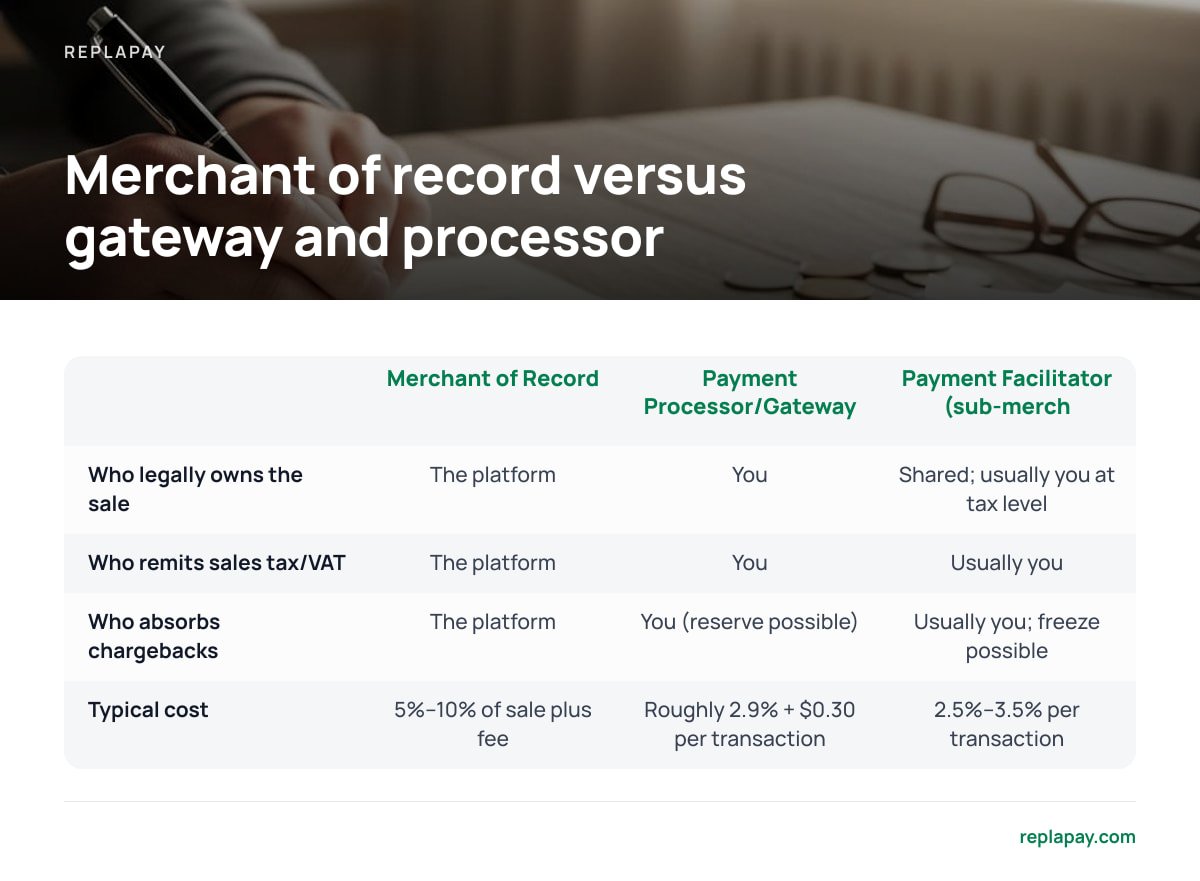
These three terms get used interchangeably in marketing copy, but they describe different levels of responsibility. The table below is the one comparison every buyer actually needs before picking a checkout setup.
| Role | Who legally owns the sale | Who remits sales tax/VAT | Who absorbs chargebacks | Typical cost |
|---|---|---|---|---|
| Merchant of Record | The platform (Paddle, FastSpring, Lemon Squeezy, Apple's App Store) | The platform | The platform | 5%–10% of the sale, plus a flat per-transaction fee |
| Payment Processor/Gateway | You | You | You (the processor may hold a reserve against disputes) | Roughly 2.9% + $0.30 per transaction |
| Payment Facilitator (sub-merchant model) | Shared, but usually you at the tax level | Usually you | Usually you; the facilitator can freeze funds pending review | 2.5%–3.5% per transaction |
The row that trips people up is the middle one. Most sellers assume that because Stripe or PayPal is processing the card, one of them must also be the merchant of record. They aren't — and that gap is exactly where sales tax obligations quietly land on you instead.
Does Stripe Act as a Merchant of Record? No — And Here's What That Distinction Costs You

Stripe is a payment processor and, for platforms built on Stripe Connect, a payment facilitator. It is not a merchant of record for a standard Stripe account. When you connect your own Stripe account to sell a product, your business is the merchant of record: your business name (or a doing-business-as name you configure) appears on the statement, your business registers for sales tax or VAT where you have obligations, and your business handles the paperwork if a customer disputes a charge. Stripe processes the payment and takes its processing fee — it does not take on your tax liability or your chargeback risk. If you want the exact math on what that processing fee looks like across different card types and currencies, What Percentage Does Stripe Take Per Transaction? breaks it down.
This is the trade sellers are actually making when they pick between a direct Stripe integration and a marketplace-style checkout: pay less per transaction and own the tax paperwork yourself, or pay a bigger cut and hand the paperwork to someone else. Neither choice is universally correct — it depends on how many tax jurisdictions you're selling into and how much volume you're doing.
Is Shopify a Merchant of Record? And What About Payhip?
Shopify
Shopify is a commerce platform, not a merchant of record. When a store uses Shopify Payments, the store owner is the merchant of record for their own sales — Shopify's payment terms are explicit that the merchant is responsible for tax collection, remittance, and compliance in the jurisdictions where they have obligations. Shopify provides the software and, in the U.S., tools to help calculate and collect sales tax, but the legal responsibility to register and file sits with the store owner, not with Shopify.
Payhip
Payhip is closer to a payment gateway than a full merchant of record. Sellers typically connect their own PayPal and Stripe accounts, meaning payments land directly with the seller rather than being collected under Payhip's business name. That's a meaningfully different setup from Gumroad, Paddle, or Lemon Squeezy, where the platform itself is the merchant of record and payments are collected under the platform's name before being paid out to the seller. If you're comparing checkout tools by whether they take on your tax liability, Payhip generally does not — you still do.
Who Actually Pays the Tax: The Merchant of Record's Real Job
Tax is the reason the merchant of record model exists at all. Selling digital goods across borders means potentially owing VAT in dozens of EU and UK jurisdictions, GST in Australia and several other countries, and sales tax across U.S. states with economic nexus thresholds. The OECD's International VAT/GST Guidelines recommend that the platform facilitating a cross-border digital sale collect and remit the tax on the seller's behalf, which is the model the EU built its VAT One-Stop-Shop (OSS) scheme around in 2021 — a single platform registration standing in for dozens of local ones. A merchant of record platform takes on exactly that job: it registers, collects, and files in every jurisdiction it operates in, so an individual seller never has to.
The flip side is that when you're the merchant of record yourself, that job doesn't disappear — it just becomes yours. You're the one deciding whether you've crossed a state's economic nexus threshold, whether you need an EU OSS registration, and whether your card processing setup meets PCI DSS requirements set by the PCI Security Standards Council for anyone handling cardholder data. None of that is optional; it's just a question of who's doing the paperwork.
Real Merchant of Record Examples, and What They All Have in Common
Apple's App Store and Google Play are merchant of record for every in-app purchase and app sale on their platforms — Apple's own developer terms confirm it collects payment, handles regional tax, and takes a commission that runs 15% to 30% depending on the developer's revenue tier and program. Paddle, FastSpring, and Lemon Squeezy run the same model for software and digital products sold outside app stores: the platform's name is on the receipt, the platform files the tax, and the platform takes a percentage — commonly landing in the 5% to 10% range once you add the flat per-transaction fee. For a deeper look at how that pricing structure is built and where it can work against you as volume grows, see What Is a Merchant of Record? The Distinction That Costs You Money.
What every one of these platforms has in common is the trade they're offering: less tax paperwork for you, in exchange for a permanent cut of every sale, forever, no matter how large your business gets.
The Trade-off the Comparison Pages Don't Run the Numbers On
Most merchant of record comparisons stop at "it handles your taxes." What they don't run is the math on when that convenience stops being worth the price. A seller doing $2,000 a month across a handful of countries is paying maybe $100 to $200 a month for tax handling they'd otherwise have to do by hand — a reasonable trade. A seller doing $50,000 a month on the same percentage is paying $2,500 to $5,000 a month for the exact same service, and the tax complexity hasn't grown 25x along with the revenue. The MoR fee scales with your sales; your actual tax burden doesn't scale nearly as fast.
Pro Tip: Before switching away from a marketplace-style checkout, pull your last twelve months of sales and check how many U.S. states and countries you actually crossed an economic nexus or VAT registration threshold in — most sellers doing under six figures a year are only obligated in one or two places, which means a direct Stripe setup with a couple of manual tax filings a year is often cheaper than the ongoing percentage, even accounting for the accountant's time.
Keep the Sale, Skip the Cut: What Replaces the Marketplace Model
If you've read this far because a marketplace-style checkout is quietly taking 5% to 13% of every sale, the alternative isn't complicated: connect your own Stripe account and your own crypto wallet directly to your checkout page instead of routing sales through someone else's merchant account. That's what ReplaPay's self-hosted checkout software does — a one-time $299 license instead of a recurring cut, with card and crypto payment links (Bitcoin, Lightning, stablecoins) that deposit straight into accounts you already own. It includes 12 months of updates and 30 days of setup support, plus a Stripe fee calculator so you can check the real math before you switch. The honest caveat: you become the merchant of record yourself, which means the tax registration and filing responsibility described above lands on you — check the spec sheet, and check your own tax exposure, before assuming this is the right trade for your volume.
Frequently Asked Questions
What does it mean to be the merchant of record?
Being the merchant of record means your business is the legal party responsible for a sale: your name appears on the transaction, you register for and remit any applicable sales tax or VAT, and you're the party who answers a chargeback dispute. If you use a marketplace-style checkout like Paddle or Lemon Squeezy, that platform is the merchant of record instead of you.
Does Stripe act as a merchant of record?
No. Stripe is a payment processor and, on platforms built with Stripe Connect, a payment facilitator, but it is not the merchant of record for a standard Stripe account. When you connect your own Stripe account, your business remains the merchant of record and keeps the tax and chargeback liability.
Is Shopify a merchant of record?
No. Shopify provides the commerce platform and payment tools, but the store owner using Shopify Payments is the merchant of record and is responsible for sales tax collection and remittance in the jurisdictions where they have obligations.
Is Payhip a merchant of record?
Generally, no. Payhip typically has sellers connect their own PayPal and Stripe accounts, which functions closer to a payment gateway than a full merchant of record setup, meaning the seller usually retains the tax and compliance responsibility rather than Payhip taking it on.
What's the difference between a merchant of record and a payment gateway?
A payment gateway moves money from a customer's card to a bank account and nothing more. A merchant of record additionally takes on the legal responsibility for the sale itself, including tax remittance and chargeback liability.
Who pays the tax under a merchant of record model?
The merchant of record platform registers for, collects, and remits sales tax or VAT on behalf of the seller in the jurisdictions where it operates. If you're not using an MoR platform and instead connect your own payment processor, that tax registration and filing responsibility stays with your business.
Sources
- Stripe Connect and payment facilitation documentation | Stripe
- PCI Data Security Standard | PCI Security Standards Council
- International VAT/GST Guidelines | OECD
- VAT One Stop Shop (OSS) | European Commission
- App Store commission structure and developer program terms | Apple