
The best Gumroad alternative for indie makers depends mostly on your sales volume and on who handles your sales tax. A long feature list matters much less. If you sell fewer than about 100 products a month or sell heavily into the EU and UK, a merchant-of-record platform that files VAT for you is often worth its fee. Past that point, a checkout that pays into your own Stripe account usually costs less, often thousands of dollars less per year.
TL;DR:
- Gumroad's published direct-sale fee is 10% plus 50¢. Owning your Stripe checkout costs 2.9% plus 30¢ on standard US cards, so a $29 sale costs $3.40 on Gumroad and about $1.14 direct.
- At $3,000 a month in $29 sales, that gap is roughly $233 a month, or about $2,800 a year.
- Tax is the real trade-off. Non-EU sellers owe EU VAT on the first digital sale to an EU consumer, and a merchant-of-record platform handles that filing for you.
- Gumroad still makes sense when you're testing a product, selling a few sales a month, or relying on its Discover marketplace for buyers you couldn't reach yourself.
- Move your direct traffic first, keep Gumroad live during the switch, and only drop it once your own checkout has handled a full month of sales.
Table of Contents
- What You Actually Pay Gumroad on a $29 Sale, and at $3,000 a Month
- Is Gumroad Worth It in 2026? Yes, Until Roughly 100 Sales a Month
- Gumroad's Competitors, Sorted by What They Take From You
- The Best Gumroad Alternative for Indie Makers Depends on Who Files Your Taxes
- Gumroad or a Craft Marketplace: Which Sells Digital Products Better?
- What Sells Best on Gumroad, and Why It Matters for Where You Move
- How to Switch Without Losing Sales: A Five-Step Migration
- Keep Roughly 96% of Every $29 Sale With a Checkout You Own
- Frequently Asked Questions
- Sources
What You Actually Pay Gumroad on a $29 Sale, and at $3,000 a Month

Most comparison pages list fees as percentages and stop there. The number that matters is dollars per month at your own price point, so start with that.
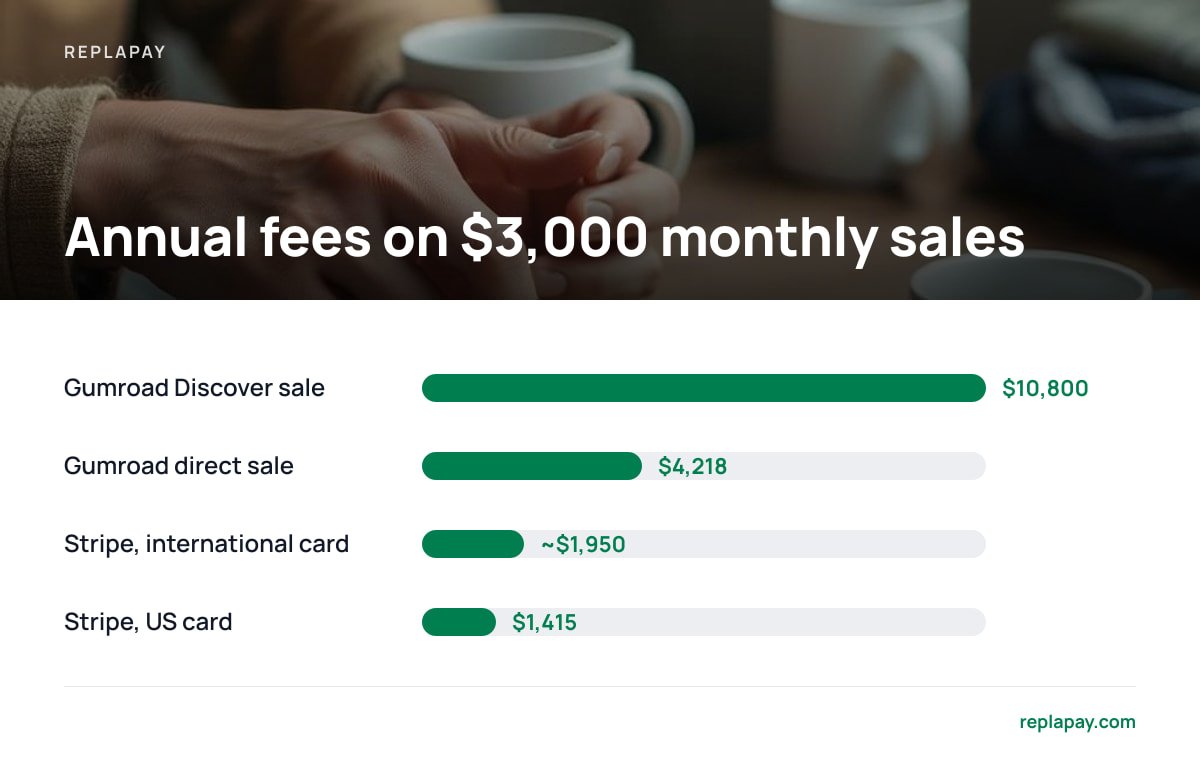
Gumroad's pricing page lists a fee of 10% plus 50¢ on direct sales. Sales that come through its Discover marketplace cost 30%. Stripe's standard US pricing is 2.9% plus 30¢ per successful domestic card charge. International cards add 1.5%, and currency conversion adds another 1%. Check Gumroad's page for whether processing is added on top for your account and region. The table below assumes it isn't, which makes Gumroad look as good as it can.
| Scenario (avg. price $29) | Fee per sale | Effective rate | Monthly cost at ~103 sales ($3,000) | Annual cost |
|---|---|---|---|---|
| Gumroad, direct sale | $3.40 | 11.7% | $351.50 | $4,218 |
| Gumroad, Discover sale | $8.70 | 30% | $900.00 | $10,800 |
| Your own Stripe checkout, US card | $1.14 | 3.9% | $117.90 | $1,415 |
| Your own Stripe checkout, international card | $1.58 | 5.4% | ~$163 | ~$1,950 |
At $3,000 a month in $29 sales, the gap between a 10% + 50¢ platform fee and Stripe's 2.9% + 30¢ is about $233 a month. That's roughly $2,800 a year.
The flat per-sale charge hits cheap products hardest. On a $9 template, Gumroad's direct fee is $1.40, or 15.6% of the sale. Stripe direct is $0.56. For a fuller breakdown, including refunds and disputes, see how much Stripe actually charges per sale and per month.
Is Gumroad Worth It in 2026? Yes, Until Roughly 100 Sales a Month
Gumroad is still worth it in 2026 for some sellers. It works well if you're testing whether a product sells at all, if you make only a handful of sales a month, or if you want someone else to deal with sales tax and VAT. Gumroad acts as the merchant of record for its sales. That means it collects and remits tax and appears as the seller on the customer's statement. Doing that yourself has a real cost in time.
It stops being worth it once your volume is steady. You can find the breakeven point against any one-time checkout cost by dividing that cost by your per-sale savings:
- $9 product. You save $0.84 per sale, so a $299 one-time cost pays for itself after about 356 sales.
- $29 product. You save $2.26 per sale, so you break even after about 132 sales.
- $49 product. You save $3.68 per sale, so you break even after about 81 sales.
Most makers selling a $29 product at around 100 sales a month recover a one-time checkout cost within their second month. If it would take you more than a year to reach your breakeven number, stay where you are. The savings don't justify the switch yet.
Gumroad's Competitors, Sorted by What They Take From You
Gumroad's competitors fall into five categories. It's more useful to compare the categories than to compare a dozen brand names, because the business model decides your costs more than any feature does.
Merchant-of-record checkout platforms
These platforms act as the legal seller, so they handle global sales tax and VAT for you. Common published rates are around 5% plus 50¢ per transaction, before extras for things like subscriptions or international payouts. Pick one of these if you sell software to customers in many countries and don't want to register for tax anywhere.
Hosted storefront builders
These platforms charge a monthly subscription, usually with a 0% to low transaction fee on top of card processing. They're cheaper than percentage-based platforms once you have volume. They usually leave tax compliance to you, though, and you pay the subscription even in months when nothing sells.
Course and community platforms
These platforms bundle hosting, video, and memberships, usually on monthly plans. They're worth it if you sell courses. They're overkill if you sell a single PDF.
General and craft marketplaces
These marketplaces bring their own buyers, in exchange for listing fees, transaction fees, and often advertising costs. The next section covers this trade-off in detail.
Self-hosted checkout on your own Stripe account
With this option, you pay only the processor's fee plus whatever your software costs. You keep the customer relationship, your payout schedule, and your data. In exchange, you take on tax registration and filing in any jurisdiction where you owe it. We cover this model in more depth in Gumroad alternatives without commission.
The Best Gumroad Alternative for Indie Makers Depends on Who Files Your Taxes

Here, the obvious answer of "pick the cheapest" can be wrong. The fee gap above is real. So is the compliance work you take on when you become the seller of record.
EU VAT has no threshold for sellers outside the EU. The European Commission's One Stop Shop lets non-EU businesses register once and file quarterly VAT returns covering every EU member state. The €10,000 cross-border threshold only applies to businesses established in the EU.
If you're outside the EU, your first €9 ebook sold to a consumer in France is subject to French VAT. No minimum sales threshold applies.
The UK works the same way. HMRC's guidance on digital services requires non-UK businesses selling digital services to UK consumers to account for UK VAT, with no registration threshold for overseas sellers.
US sales tax depends on the state. Since the Supreme Court's 2018 decision in South Dakota v. Wayfair, states can require remote sellers to collect sales tax once they pass an economic threshold. Whether digital goods are taxable at all varies by state. We explain the details in how VAT works for US online sellers.
The honest recommendation goes like this. If more than about a third of your revenue comes from EU and UK consumers and you make under roughly $1,500 a month, a merchant-of-record platform's extra few percent may cost less than an accountant's time. Above that level, or if most of your buyers are in the US or are businesses, your own checkout usually wins clearly.
Pro Tip: Before you switch, export a year of your sales and sort it by buyer country. Most makers guess their EU share is much higher than it actually is. If 85% of your revenue is US-based, the tax argument for staying on a merchant-of-record platform mostly disappears. You can also handle the remaining EU sales through a single One Stop Shop registration instead of 27 separate ones.
Gumroad or a Craft Marketplace: Which Sells Digital Products Better?
Neither is better overall. The right choice depends on where your buyers come from.
Choose a craft marketplace if you have no audience and sell printables. Planners, wall art, and party templates sell there because buyers are already searching for those items. You pay listing fees, transaction fees, and processing, and you'll often need paid ads to show up in search. You also compete on price against thousands of nearly identical listings, and you never really own the customer.
Choose Gumroad if you already bring your own traffic. Gumroad suits creators whose buyers arrive from a newsletter, a YouTube channel, or an X following. Its checkout is cleaner for software, courses, and pay-what-you-want pricing, and you can export customer emails.
Choose neither once your traffic is your own and steady. If 90% of your buyers click a link you posted, you're paying a marketplace-level fee without getting any marketplace discovery in return.
What Sells Best on Gumroad, and Why It Matters for Where You Move
Gumroad doesn't publish an official ranking of its top products. The categories that consistently do well on the platform are:
- Design assets. Fonts, icon packs, UI kits, and Figma files sell at $15 to $79 to designers who buy on impulse.
- Productivity templates. Planning systems and workspace templates sell, often at low prices where the 50¢ flat fee takes the largest share.
- Software and plugins. These include code snippets, scripts, and plugins that need license keys.
- Courses and tutorials. Video courses and cohort material carry higher prices, where percentage fees add up to the most dollars.
- Ebooks and guides. Niche how-to content sells well to an existing audience.
- Photo and video presets. Lightroom presets and LUT packs sell steadily through social media.
Your product type should shape where you move. Software makers need license key delivery and possibly subscriptions. Template sellers need instant file delivery and low per-sale costs. Course creators may genuinely need a course platform. Before you choose, compare one-time and recurring checkout costs using software license vs. subscription checkout.
How to Switch Without Losing Sales: A Five-Step Migration
- Export everything first. Download your customer list, sales history, and product files. Customer emails are what you're really moving.
- Set up your new checkout and run a $1 test purchase. Confirm the payment lands, the file is delivered, and the receipt email arrives.
- Move your direct links before anything else. Update the links in your newsletter, link-in-bio, website, and pinned posts. This traffic is where the fee savings come from.
- Leave your Gumroad listings live for 30 to 60 days. Old links in old tweets and YouTube descriptions will keep sending buyers there. Let those sales finish where they started.
- Tell existing customers how to get updates. If you ship file updates, email past buyers with download access from the new system.
Keep Roughly 96% of Every $29 Sale With a Checkout You Own

ReplaPay is a self-hosted checkout you buy once for $299. It pays directly into your own Stripe account, so a $29 sale costs you Stripe's roughly $1.14 instead of a platform's $3.40 or more. It also accepts Bitcoin, Lightning, and stablecoin payments straight into your wallet. You can create payment links for any product in a few minutes. The license includes 12 months of updates and 30 days of setup support. Our free Stripe fee calculator shows your exact breakeven point before you spend anything.
Here's the caveat. ReplaPay is not a merchant of record, so you are responsible for your own tax registration and filing. If EU VAT paperwork is a dealbreaker for you and your volume is low, run the numbers first, and check the spec sheet to confirm it supports the delivery features your product needs.
Frequently Asked Questions
What is the cheapest Gumroad alternative for indie makers?
For steady sellers, the cheapest option is usually a checkout connected to your own Stripe account, which costs 2.9% plus 30¢ per standard US card sale. Gumroad's direct-sale fee is 10% plus 50¢. The cheapest option on paper can still cost more once you account for tax compliance if most of your buyers are EU or UK consumers.
How many sales do I need before leaving Gumroad makes sense?
Divide the cost of your new setup by your per-sale savings. On a $29 product you save about $2.26 per sale, so a $299 one-time checkout pays for itself after roughly 132 sales. If reaching that number would take you more than a year, staying is reasonable.
Do I have to charge VAT if I sell digital products outside a platform?
Usually, yes. Sellers outside the EU owe EU VAT from the first digital sale to an EU consumer, and the UK applies the same rule with no threshold for overseas sellers. The EU's One Stop Shop scheme lets you register once and file a single quarterly return for all member states.
Can I keep Gumroad and use another checkout at the same time?
Yes, and that's the safest way to switch. Send your newsletter and website traffic to your new checkout, and leave your Gumroad listings live so old links keep converting. Close them once your new checkout has handled a full month of sales without problems.
Is Gumroad's Discover marketplace worth the 30% fee?
It can be, because Discover sales come from buyers you wouldn't have reached on your own. If Discover makes up a meaningful share of your revenue, keep those listings on Gumroad and move only your direct traffic. If almost all your buyers come from your own links, you're paying for discovery you don't use.
Sources
- Stripe Pricing & Fees | Stripe
- Gumroad Pricing | Gumroad
- VAT One Stop Shop | European Commission
- The VAT rules if you supply digital services to private consumers | HM Revenue & Customs (GOV.UK)