

Stripe actually charges 2.9% plus 30¢ per successful US card payment, with no monthly or setup fee. That headline rate is rarely your real rate. International cards, currency conversion, subscription billing, tax calculation, and disputes each stack on top. The 30¢ fixed fee also matters more than the percentage on small sales. A $100 domestic sale costs $3.20, but a $5 sale costs almost 9%.
TL;DR:
- Stripe's standard US price is 2.9% + 30¢ per successful card charge, with no monthly fee, setup fee, or minimum.
- A $100 domestic card sale costs $3.20, so you receive $96.80. The same sale on an international card that needs currency conversion costs $5.70.
- Below about $10.34, the fixed 30¢ is larger than the 2.9% percentage fee, so cheap products lose a much bigger share to fees.
- Subscription billing, tax calculation, and disputes are separate charges. Refunds do not return the original processing fee.
- For most sales over $20, Stripe's fees are market rate. Marketplace checkout platforms that take 5–13% are usually the bigger leak.
Table of Contents
- How Much Stripe Actually Charges Per Transaction, Line by Line
- How Much Is the Stripe Fee for $100? Four Versions of the Same Sale
- Why Small Sales Get Hit Hardest: The 30-Cent Problem
- Does Stripe Have a Monthly Fee, and What Does It Cost Per Month?
- Fees on Fees: The Costs Sellers Notice Too Late
- Are Stripe Fees Too High? A Straight Answer
- The Real Downsides of Using Stripe, Beyond Price
- Keep the Platform Cut Without Paying It: Your Own Checkout, One Price
- Frequently Asked Questions
- Sources
How Much Stripe Actually Charges Per Transaction, Line by Line
Stripe's published pricing for US businesses starts at 2.9% + 30¢ per successful domestic card charge. You pay that only when a payment succeeds. Failed charges cost nothing, and there is no monthly subscription for the standard plan.
The headline rate is the floor. Other fees attach to specific kinds of transactions or specific Stripe products:
| Fee | What triggers it | Cost (US, standard pricing) |
|---|---|---|
| Card processing | Every successful domestic card charge | 2.9% + 30¢ |
| International card | Card issued outside the US | +1.5% |
| Currency conversion | Customer pays in a currency other than your payout currency | +1% |
| Manually entered card | Card number typed in rather than collected online | +0.5% |
| ACH Direct Debit | Bank payment instead of card | 0.8%, capped at $5 |
| Dispute (chargeback) | A customer disputes the charge with their bank | $15 per dispute |
| Stripe Billing | Recurring subscriptions managed by Stripe | 0.7% of billing volume |
| Stripe Tax | Automatic sales tax / VAT calculation | 0.5% per transaction where you're registered |
These are Stripe's published US rates at the time of writing. They vary by country and by negotiated plan, so check Stripe's own pricing page for your account before you build a budget on them.
So how much does Stripe charge per transaction? For a typical domestic card sale, you pay 2.9% of the total plus 30¢. Every extra in the table above is added to that base, not swapped in for it.
How Much Is the Stripe Fee for $100? Four Versions of the Same Sale
The same $100 sale can cost you anywhere from $3.20 to over $5, depending on who buys and how you charge them.
| Scenario | Fee calculation | Total fee | You receive |
|---|---|---|---|
| Domestic card, one-time | 2.9% + 30¢ | $3.20 | $96.80 |
| Domestic card, subscription via Stripe Billing | 2.9% + 0.7% + 30¢ | $3.90 | $96.10 |
| Subscription + Stripe Tax | 2.9% + 0.7% + 0.5% + 30¢ | $4.40 | $95.60 |
| International card + currency conversion | 2.9% + 1.5% + 1% + 30¢ | $5.70 | $94.30 |
The plain answer for a $100 sale is $3.20. That figure only holds for a US customer paying with a US card in US dollars, on a one-time charge, with no add-on products.
If you sell software or digital products to a global audience, the last row is the one to plan around. On a $100 sale, an international buyer paying in euros or pounds can cost you roughly 78% more in fees than a domestic buyer.
Why Small Sales Get Hit Hardest: The 30-Cent Problem

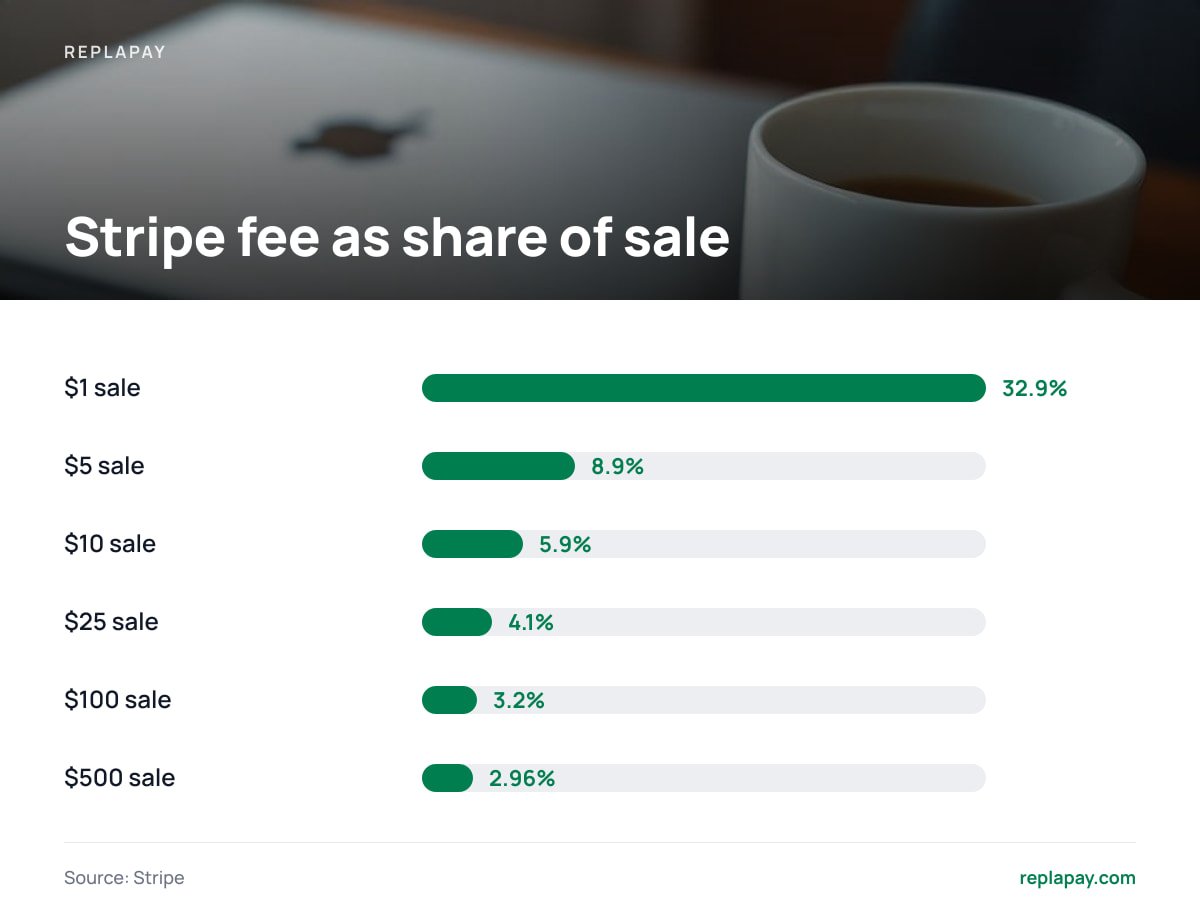
The percentage fee gets most of the attention. For low-priced products, the fixed 30¢ does most of the damage. Here is the fee as a share of the sale at different price points, on domestic cards:
- $1 sale. 2.9¢ + 30¢ = 32.9¢. That is 32.9% of the sale.
- $5 sale. 14.5¢ + 30¢ = 44.5¢. That is 8.9%.
- $10 sale. 29¢ + 30¢ = 59¢. That is 5.9%.
- $25 sale. 72.5¢ + 30¢ = $1.03. That is 4.1%.
- $100 sale. $2.90 + 30¢ = $3.20. That is 3.2%.
- $500 sale. $14.50 + 30¢ = $14.80. That is 2.96%.
At any price below $10.34, Stripe's fixed 30¢ costs you more than its 2.9% percentage fee.
This explains why two sellers with identical monthly revenue can face very different effective rates. Suppose a seller makes $10,000 a month from 400 sales at $25 each. They pay about $410 in fees, or 4.1%. Another seller makes the same $10,000 from 2,000 sales at $5 each. They pay about $890, or 8.9%. The rate card is the same for both. The cost is more than double.
Pro Tip: If you sell low-priced items, raising your price matters less than raising the size of each payment. Bundles, credit packs, and annual plans all collect more money in fewer charges. For example, twelve $5 monthly charges cost $5.34 in fees in total. One $60 annual charge costs $2.04. Same customer, same revenue, 62% less in fees.
Does Stripe Have a Monthly Fee, and What Does It Cost Per Month?
Stripe's standard pricing has no monthly fee, setup fee, or minimum volume. Opening an account and leaving it unused costs nothing. You only start paying when money moves.
"How much does Stripe cost per month" therefore has no fixed answer. Your monthly cost is your sales volume multiplied by your effective rate. You can estimate it in three steps:
- Count your transactions, not just your revenue. Multiply the number of charges by 30¢. This is your fixed-fee cost.
- Apply the percentage to gross volume. Multiply total revenue by 2.9%. Then add 1.5% plus 1% for the share of revenue from international buyers paying in another currency.
- Add your product fees. Add 0.7% of subscription revenue if you use Stripe Billing, and 0.5% if you use Stripe Tax. Then add $15 for each dispute you expect.
A Stripe fee calculator does this math for you. Feed it your real transaction count and customer mix, not just a single sale amount. Calculators that only ask for one price will understate your costs if you sell small items or sell abroad.
Fees on Fees: The Costs Sellers Notice Too Late

Sellers who complain on Reddit that Stripe charges "fees on fees on fees" are usually describing one of these four things. None of them appears in the 2.9% headline.
Refunds keep the processing fee
When you refund a customer, Stripe does not return the original processing fee. Stripe's refund documentation says this directly. A fully refunded $100 sale still costs you $3.20. This makes a generous refund policy cost you real money per request. Factor it in if your product has a high refund rate.
Disputes cost money even when you win
A chargeback triggers a dispute fee, which is $15 in the US. Stripe's dispute documentation covers how the process and fees work. The disputed amount is pulled from your balance while the case is open. On a $10 product, one dispute can cost more than the sale earned.
Product fees stack on top of payment fees
Stripe Billing and Stripe Tax are each priced as a percentage of volume. They are added on top of card processing; they do not replace it. You can find the current subscription rate on Stripe's Billing pricing page. A subscription business using both tools pays roughly 4.1% + 30¢ on a domestic charge before any international surcharge.
Your international share changes your rate
If 40% of your buyers are outside the US, your blended percentage rises well above 2.9%. Tax is a related complication. Collecting from overseas buyers can create VAT obligations that Stripe Tax calculates but does not file for you. Our guide to how VAT works for US online sellers covers when that applies.
Are Stripe Fees Too High? A Straight Answer
For most sellers whose average sale is above $20, no. Stripe's 2.9% + 30¢ is roughly market rate for online card processing. A large part of it is interchange, the fee your customer's card-issuing bank charges on every card transaction. That cost exists whichever processor you use. Even debit card interchange is regulated rather than optional: the Federal Reserve's Regulation II sets a cap for large issuers, but the cap is not zero.
Stripe fees really are too high in three situations:
- Very low average sale price. Below about $10, the fixed fee pushes your effective rate toward double digits.
- Large monthly volume on standard pricing. Stripe offers custom pricing for larger businesses. If you process high volume and have never asked, you are probably paying the list rate when you don't have to.
- Heavily international customers. Once you add the international and conversion fees, the true rate on those sales is 5.4% + 30¢.
The bigger leak is usually somewhere else. Many creators don't pay Stripe directly. They sell through a marketplace checkout platform that takes 5–13% of every sale, often on top of the processing cost built into that fee. On $10,000 a month, the difference between paying 3.2% to a processor and 10% to a platform is about $680 a month. We break down that comparison in the fee and tax math for marketplace checkout alternatives.
Paying Stripe 3.2% directly instead of 10% through a marketplace saves about $8,160 a year on $10,000 in monthly sales.
The Real Downsides of Using Stripe, Beyond Price
Price is only one of Stripe's trade-offs. If you are deciding whether to run payments through your own Stripe account, weigh these too:
- Account reviews and holds. Stripe can pause payouts, hold a reserve, or close an account it judges high-risk. This happens most often after a sudden spike in volume or a run of disputes. You carry that risk directly. A marketplace platform would absorb it for you.
- You are the merchant. With your own account, sales tax, VAT, chargebacks, and receipts are your responsibility. Stripe offers tools for each, but most of those tools cost extra.
- Payout timing. Standard payouts land on a rolling schedule rather than instantly. Faster payouts cost an additional fee.
- Support is mostly self-serve. Small accounts generally rely on documentation and chat rather than a dedicated contact.
- No fee refunds. As covered above, refunds and won disputes don't return your processing costs.
None of these is a reason to avoid Stripe. They are reasons to read your account's terms before you depend on it. For sellers above a few thousand dollars a month, a direct Stripe account still beats a platform charging 5–13%. The extra work costs less than the commission.
Keep the Platform Cut Without Paying It: Your Own Checkout, One Price

If this math showed that your real loss is the marketplace commission rather than Stripe, ReplaPay is built for that problem. It is self-hosted checkout software that sends card payments straight into your own Stripe account. It also accepts crypto, including Bitcoin, Lightning, and stablecoins, paid directly into your own wallet. You can create payment links for both. The license is a one-time $299, with 12 months of updates and 30 days of setup support. It includes a Stripe fee calculator, so you can run the estimate from the steps above against your own transaction mix.
The honest limit: ReplaPay removes the platform's percentage, not Stripe's. You still pay 2.9% + 30¢ and every surcharge in this article. You also become the merchant of record, so tax collection and filing are your job. If you sell a few hundred dollars a month, the $299 may take a while to pay back. Run the numbers in our guide to selling digital products without a marketplace cut first.
Frequently Asked Questions
How much is the Stripe fee for $100?
On a domestic US card, Stripe charges $3.20 on a $100 sale (2.9% plus 30¢), so you receive $96.80. If the card is international and needs currency conversion, the fee rises to $5.70. Subscription billing and tax tools add more on top.
Does Stripe have a monthly fee?
Stripe's standard pricing has no monthly fee, setup fee, or minimum volume. You pay only per successful transaction, plus any optional products you turn on, such as Stripe Billing or Stripe Tax. Your monthly cost depends entirely on your sales volume and customer mix.
How much does Stripe charge for subscriptions?
Recurring charges pay the normal card rate of 2.9% plus 30¢ per payment in the US. If you use Stripe Billing to manage subscriptions, it adds a percentage of billing volume, listed at 0.7% on Stripe's pay-as-you-go pricing at the time of writing. Check Stripe's Billing pricing page for your current rate.
How much does Stripe charge for international payments?
For US accounts, international cards add 1.5% to the standard 2.9% plus 30¢. If the payment also requires currency conversion, another 1% applies. That makes the total 5.4% plus 30¢ on those sales.
Does Stripe refund fees when you refund a customer?
No. Stripe does not return the original processing fee when you issue a refund. A fully refunded $100 domestic sale still costs you $3.20.
Are Stripe fees too high for small businesses?
For average sales above about $20, Stripe's rates are roughly market standard for online card processing. They become expensive for very low-priced items, because the fixed 30¢ can exceed 8% of a $5 sale. For many creators, a marketplace platform's 5–13% commission is a far bigger cost than Stripe itself.
Sources
- Pricing & Fees | Stripe
- Stripe Billing Pricing | Stripe
- Refunds documentation | Stripe
- Disputes documentation | Stripe
- Regulation II (Debit Card Interchange Fees and Routing) | Board of Governors of the Federal Reserve System